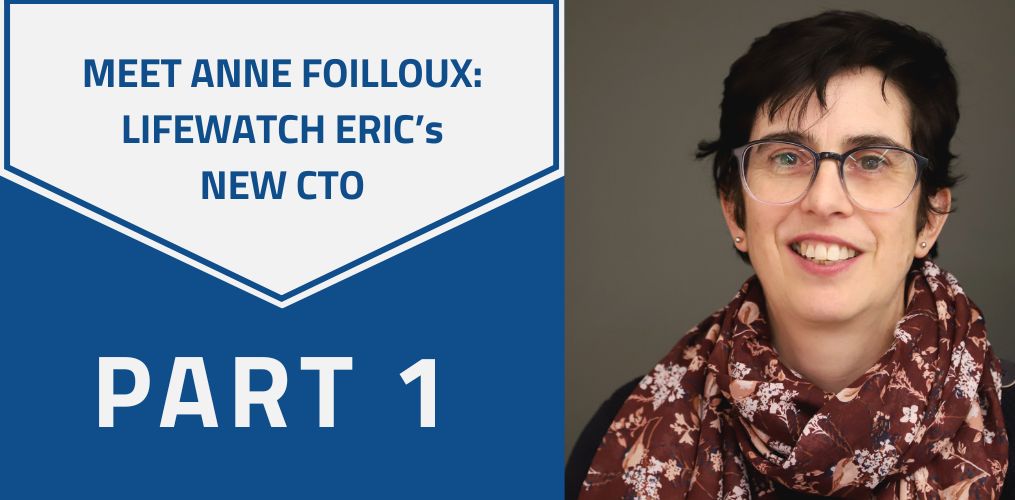
November 2025 marks an important transition for LifeWatch ERIC, with the arrival of its new Chief Technology Officer, Anne Fouilloux. In this role, Anne will guide the development of LifeWatch ERIC’s technological strategy and strengthen the organisation’s capacity to serve the biodiversity and ecosystem research community across Europe.
We had the pleasure of sitting down with her for a conversation about her vision, and what she hopes to build together with our community. Anne brings over two decades of experience in Open Science, FAIR principles, and Research Infrastructures. She has dedicated her work to build seamless information flows connecting scientists, researchers, and technologists, working across academia, international organisations, and scientific collaborations in Norway, the UK, and France.
This two-part interview begins by focusing on Anne’s professional journey: the experiences that shaped her, real-life examples from her day-to-day work, and how this perspective will inform her approach as CTO.
Anne, what brought you to LifeWatch ERIC at this moment of your career? What made you feel that this was the right next step for you?
“The ‘e‘ in e-infrastructure, that digital ecosystem connecting people, data, and tools across borders, has always fascinated me. I first experienced its potential during the EOSC-Nordic project with the Nordic e-Infrastructure Collaboration, where we enabled ecologists to run complex Earth system models through user-friendly interfaces and automated workflows. Working across distributed networks showed me how combining different perspectives under a common mission achieves far greater impact than isolated efforts. LifeWatch ERIC’s distributed structure resonates deeply with my experience. The timing feels right because there’s tremendous opportunity ahead for LifeWatch ERIC. And on my side, after years supporting grassroots research community through initiatives like Pangeo big Data geoscience, and the Galaxy Project, I’m excited to contribute strategically to infrastructure with both the mandate and mission to maximise impact for biodiversity research across Europe.”
You bring over 25 years of experience in research software engineering, open science practices, knowledge transfer, and bridging gaps between science and industry. How will this background shape your approach at LifeWatch ERIC?
“I’ve learned that successful infrastructure requires understanding users deeply, enabling innovation through thoughtful governance, recognising the work done by the technical and scientific teams that support users, and critically, planning for both today and tomorrow. In e-infrastructure, this is amplified:
- Balancing present and future is essential. At ECMWF, the system had to run operationally every six hours while also supporting cutting-edge research. This taught me you can’t just optimise for today or dream about tomorrow: you need both. You maximise what exists while preparing infrastructure and people for what’s coming. My priority is helping us make the best of our current resources while establishing a clear strategic roadmap. LifeWatch ERIC has valuable capabilities, from computational resources to tools to people. Strategic coordination helps us amplify these strengths.
- Preparing users and staff is as important as preparing infrastructure. At ECMWF, we introduced an observational data governance that helped scientists integrate their research into operations smoothly. When leading the Nordic e-Infrastructure Collaboration for Earth System Tools (NICEST), we helped Nordic researchers prepare for next-generation computing. It’s never just about the technology: it’s about ensuring people can actually use it effectively and build on each other’s work.
- Strategic collaboration multiplies impact. We can’t build everything ourselves, nor should we. My collaboration work with ELIXIR, EGI, Euro-BioImaging, and through EOSC taught me that smart collaboration with other Research Infrastructures lets us focus where we add unique value while leveraging others’ expertise for shared needs. This is particularly critical for LifeWatch ERIC in the context of EOSC nodes and in leveraging or preparing for technologies such as AI and quantum computing, as well as evolving cybersecurity challenges, where effective partnerships are indispensable.”.
Stay tuned for the second part of this interview! Anne will share her vision on how to turn data into impact, and how LifeWatch ERIC can contribute to breaking down silos and enable cross-discipline collaboration and synthetic knowledge.