ITINERIS (https://itineris.cnr.it/) is an initiative started in November 2022 with the objective to support the Italian integrated system of Research Infrastructures (RIs) in the environmental domain, under the coordination of the National Research Council (CNR) of Italy.
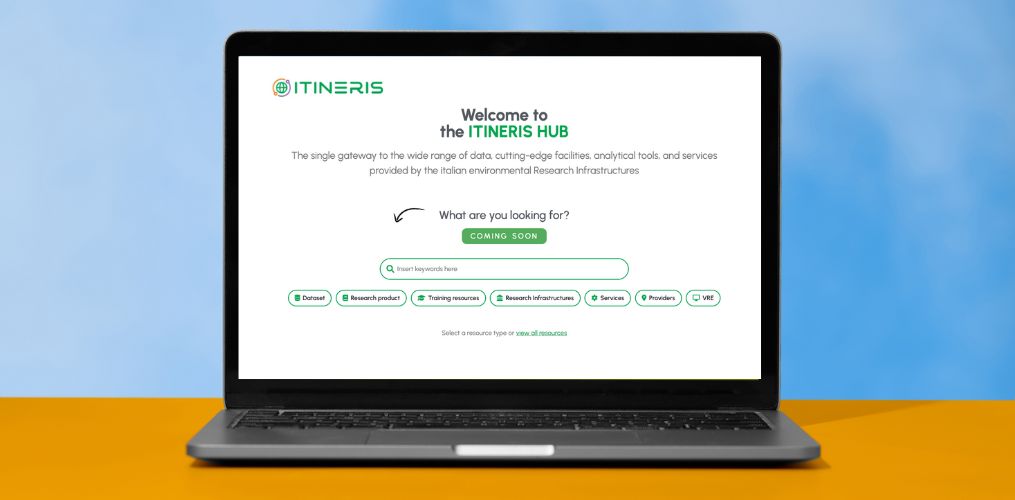
One of its main outputs is the ITINERIS HUB, a gateway to the wide range of data, cutting-edge facilities, analytical tools, and services from these RIs, facilitating observation and study of processes in the atmosphere, marine domain, terrestrial biosphere, and geosphere. Italy is in fact actively involved in all major pan-European Environmental Research Infrastructures, and hosts other nationally relevant RIs, demanding for coordinated actions to integrate, interlink and harmonise their activities.
The ITINERIS HUB includes digital tools such as datasets, research products, and training resources among others, as well as Virtual Research Environments (VREs), that is, web-based, community-oriented working environments that enable researchers to work remotely and interactively.
Now in its final phases, ITINERIS has recently launched a VREs training event in two sessions, on 27 and on 30 January. The event will be an opportunity to train the platform super-admins and admins on two newly launched VREs developed in collaboration with LifeWatch ERIC by EquiUP SRL. The first one, Biomass VRE, helps study aquatic and terrestrial biomass dynamics in relation to climatic, ecological, and anthropogenic factors, while the second one, Phyto VRE, allows phytoplankton data computation and analysis.
After the training events, the final version of the platform will be presented to its end-users in another session on Friday 30 January at 15:00, together with some practical case studies to help in the adoption of its tools.
Researchers are just beginning to understand the series of intricate relations governing our planet: this is one of modern science’s biggest challenges in the face of today’s critical issues. Platforms like ITINERIS HUB can help elaborate and interpret the huge quantity of data available from different sources and offer a new understanding of nature.