Source: EGI FOundation press release
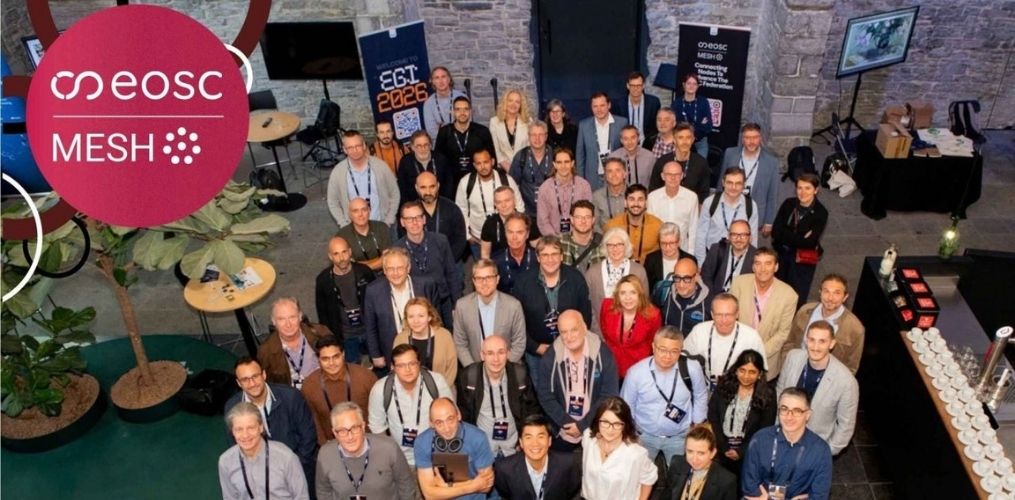
From 24 to 25 September 2026, LifeWatch ERIC was involved in the EOSC Mesh kick off meeting in Ghent, Belgium. Adrian Guerrero Bermudez, Hybrid Cloud Data Centre & Software Systems Operation Manager at LifeWatch ERIC ICT Core, and Zhiming Zao, VLIC Technical Manager, joined the meeting.
Launched by a consortium of 46 organisations and coordinated by the EGI Foundation, EOSC Mesh – Connecting Nodes to Advance the EOSC Federation is an initiative designed to strengthen the European Open Science Cloud (EOSC) by connecting research infrastructures, digital services and scientific communities across Europe.
EOSC Mesh will establish seven interoperable EOSC Nodes covering environmental sciences, social sciences and humanities, life sciences, high-energy physics, scholarly communication and e-infrastructures. Together, these Nodes will form a distributed EOSC Mesh Hub, offering 25 federating capabilities to help researchers discover, access, process and reuse data, software, workflows and other research outputs across organisational and national boundaries.
LifeWatch ERIC is involved in WP3 activities, supporting the planning, set-up, integration and delivery of Nodes into the EOSC Federation.
The project will provide a continuum of federated data, compute and storage resources, supported by services for authentication, cataloguing, federated search, workflow management, secure processing of sensitive data, data transfer, provenance and service monitoring. This will make it easier for research communities to combine resources from different infrastructures and run reproducible, cross-border workflows.
“EOSC Mesh will turn federation into a practical experience for researchers and infrastructure providers,” said Diego Scardaci, EGI Foundation (project coordinator). “By connecting independent Nodes through shared services, technical expertise and coordinated support, we can make European research resources easier to find, access and reuse.”
The project will demonstrate the value of the EOSC Mesh Hub through seven scientific use cases, including AI model validation on sensitive health data, cross-Node particle-physics workflows, environmental monitoring, analysis of volcanic eruptions, ocean-risk prevention and the discovery of historical newspaper data. EOSC Mesh will also support new providers and potential Node operators through training, open calls, technical assistance and a dedicated Node Operator Framework.
EOSC Mesh will work closely with the EOSC Partnership, the EOSC EU Node, other EOSC Nodes and related European initiatives. Its results will help lower the barriers for future organisations wishing to join the EOSC Federation.
For more information, visit the project website.
Picture from LinkedIn