LifeWatch ERIC Executive Board members to speak at the ‘XXX° Rassegna del mare’

Rassegna del mare

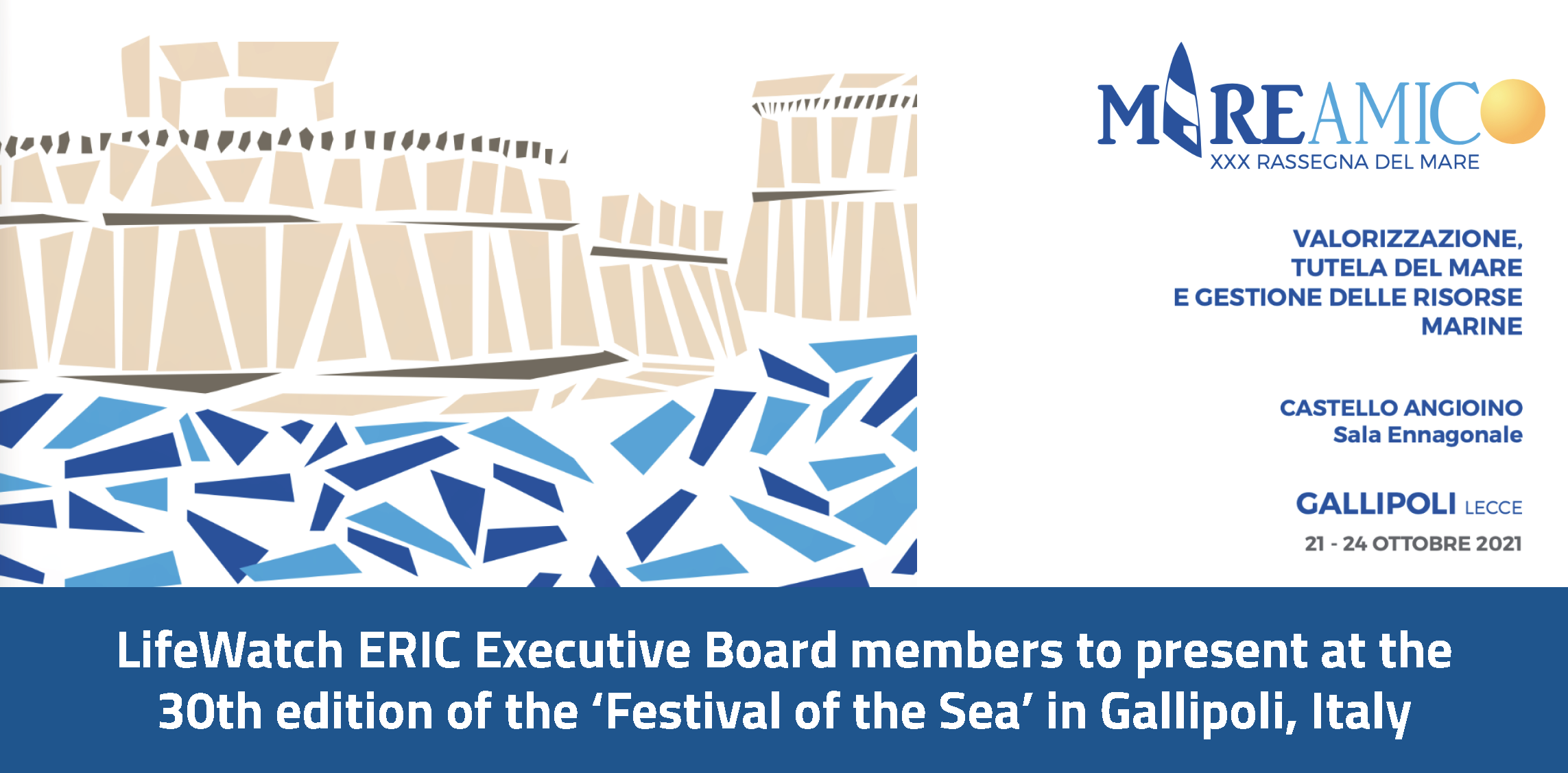
From 21 – 24 October, the Italian city of Gallipoli will host the XXX° Rassegna del mare (30th Festival of the Sea), organised by MareAmico, with the patronage of the Italian National Research Council and the contribution of several LifeWatch ERIC experts, scientists and representatives. This edition, which will be held in-person in compliance with anti-Covid regulations, will be based on the topic “Recognition and protection of the sea and marine resource management”.

With a range of activities taking place, the goal of the event is to raise awareness among institutions (the EU, competent ministries, the Puglia Region and local authorities) on the importance of ocean resources and their management. The round tables will be attended by international experts, who will participate in debates on this edition’s issues and topics.


Among the moderators of the event is Alberto Basset, Director of LifeWatch ERIC’s Service Centre, Manager of the LifeWatch Italy JRU (Joint Research Unit), and member of the Festival’s Organising Committee. On Saturday 23 October, during the round table “Alien Species: from threat to opportunity, the case studies of LifeWatch ERIC on the invasive blue crab (Callinectes sapidus)”, Christos Arvanitidis, LifeWatch ERIC CEO, and Juan Miguel González-Aranda, LifeWatch ERIC CTO, will present the results of the infrastructure’s Internal Joint Initiative on the theme of non-indigenous and invasive species. The work will be summed up in a report, which is going to be discussed in plenary assemblies and further worked on by the MareAmico Scientific Committee. This final document should represent the groundwork for subsequent deliberative and operational decisions.


Recreational and educational areas will be set up for younger participants, who will have the opportunity to participate in activities aimed at raising awareness on environmental issues, mainly concerning marine resources and fishing. Participants and tourists gathering at the stands will get the chance to witness the fish landing, and will be invited to enjoy the show’s cooking events, using local products.

You can read the programme here (in Italian).

Policy Relevance and Uptake

  • End of May 2026 – Policy-brief to demonstrate the application of habitat-based mapping in supporting EU strategies (e.g., Biodiversity Strategy, Nature Restoration Law).

Mapping user requirements

  • End of January 2025 – Catalogue of services already available in LifeWatch ERIC or research lines addressing ecological responses to climate change;
  • February 2025 (TBD) – Online working table on setting priorities, timeline and milestones for the mapping service and model requirements by scientists and science stakeholders.
Greece

The Greek National Distributed Centre is funded by the Greek General Secretariat of Research and Technology and is coordinated by the Institute of Marine Biology, Biotechnology and Aquaculture of the Hellenic Centre for Marine Research, in conjunction with 47 associated partner institutions.

To know more about how Greece contributes to LifeWatch ERIC, please visit our dedicated webpage.

Italy

The Italian National Distributed Centre is led and managed by the Italian National Research Council (CNR) and is coordinated by a Joint Research Unit, currently comprising 35 members. Moreover, Italy hosts one of the LifeWatch ERIC Common Facilities, the Service Centre.

To know more about how Italy contributes to LifeWatch ERIC, please visit our dedicated webpage.

Netherlands

The Dutch National Distributed Centre is hosted by the Faculty of Science of the University of Amsterdam. Moreover, The Netherlands hosts one of the LifeWatch ERIC Common Facilities, the Virtual Laboratory and Innovation Centre.

To know more about how The Netherlands contributes to LifeWatch ERIC, please visit our dedicated webpage.

Portugal

The Portuguese National Distributed Centre is managed by PORBIOTA, the Portuguese e-Infrastructure for Information and Research on Biodiversity. Led by BIOPOLIS/CIBIO-InBIO – Research Centre in Biodiversity and Genetic Resources, PORBIOTA connects the principal Portuguese research institutions working in biodiversity.

To know more about how Portugal contributes to LifeWatch ERIC, please visit our dedicated webpage.

Slovenia

The Slovenian National Distributed Centre is led by the Research Centre of the Slovenian Academy of Sciences and Arts (ZRC SAZU). It focuses on the development of technological solutions in the field of biodiversity and socio-ecosystem research.

To know more about how Slovenia contributes to LifeWatch ERIC, please visit our dedicated webpage.

Spain

The Spanish National Distributed Centre is supported by the Ministry of Science, Innovation and Universities, the Regional Government of Andalusia and the Guadalquivir River Basin Authority (Ministry for Ecological Transition-MITECO). Moreover, Spain is the hosting Member State of LifeWatch ERIC, the location of its Statutory Seat & ICT e-Infrastructure Technical Office (LifeWatch ERIC Common Facilities). 

To know more about how Spain contributes to LifeWatch ERIC, please visit our dedicated webpage.

Bulgaria

The Bulgarian National Distributed Centre is represented by the  Agricultural University-Plovdiv.

To know more about how Bulgaria contributes to LifeWatch ERIC, please visit our dedicated webpage.

Implementing services

  • End of January 2025 – Internal distribution of a questionnaire on the most used/relevant model resources in the WG member research activity;
  • February 2025 (TBD) – Online working table on setting priorities, timeline and milestones for the mapping service and model requirements by scientists and science stakeholders.

Knowledge Exchange and Capacity Building

  • End of December 2025 – Create a shared repository of guidance documents, tools, templates, and data resources accessible to WG members and broader communities.

Organising WG workshops and conferences

  • End of January 2025 – Setting priority research lines and contributions to the BEeS 2025 LifeWatch Conference for the session on the “Ecological responses to climate change”;
  • March/April 2025 (TBD) – Workshop ‘Ecological modelling and eco-informatics to address functional responses of biodiversity and ecosystems to climate change’ co-organised with the University of Salento;
  • 30 June – 3 July 2025 – Participation to LifeWatch 2025 BEeS Conference on “Addressing the Triple Planetary Crisis”.

Fund raising

  • End of January 2025 – Establishing a WG Committee on scouting project application opportunities and fundraising.

Meetings, Webinars, International Conferences & Networking (2025/2026)

  • Organising and participating at discussions on emerging technologies in biodiversity monitoring;
  • Organising webinars on machine learning, eDNA analysis, and automated data collection;
  • Fostering collaboration between researchers, technologists, and decision-makers.

Collaborative Research & Case Studies (2025/2026)

  • Conducting pilot projects to test new monitoring methods;
  • Publishing scientific and popular science papers and reports on advancements in biodiversity assessment.

Data Standardisation & FAIR Principles Implementation (2025/2026)

  • Developing best practices for data curation and sharing;
  • Ensuring that biodiversity data aligns with FAIR (Findable, Accessible, Interoperable, Reusable) standards.

Development of VREs for Ecosystem Simulation (2026)

  • Creating virtual models of ecosystems to predict environmental changes;
  • Enhancing conservation strategies through AI-driven simulations.

Mapping Requirements and Gap Analysis

  • End of December 2025 – Catalogue of services already available in LifeWatch ERIC or research lines Ecosystem services mapping.

Methodological Alignment and Innovation

  • End of January 2026 – Online working table on mapping standards, classification systems, and indicators across members;
  • End of January 2026 – Catalogue of advanced techniques (e.g., remote sensing, GIS modelling, and machine learning) for scalable, habitat-based ecosystem service mapping;
  • End December 2026 – Methodological framework to support methodological innovation through joint development and testing of mapping approaches, especially linking ecosystem service supply and demand.
Belgium

The Belgian National Distributed Centre makes varied and complementary in-kind contributions to LifeWatch ERIC. These are implemented in the form of long-lasting projects by various research centres and universities distributed throughout the country and supported by each respective political authority.

To know more about how Belgium contributes to LifeWatch ERIC, please visit our dedicated webpage.