
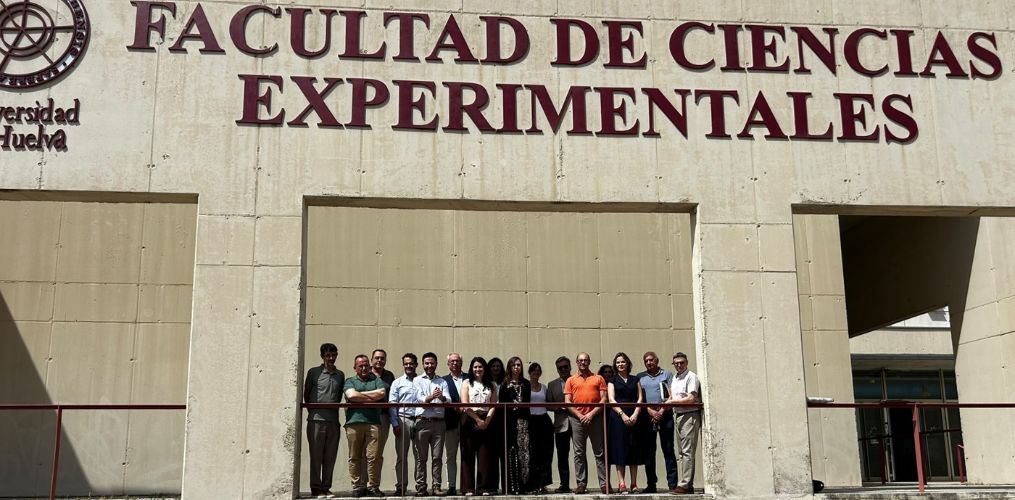
On 24 June, the Faculty of Experimental Sciences at the University of Huelva hosted the third Executive Monitoring Committee meeting for the RECUP-DAS project, an initiative co-funded by the European Union through the Andalusia ERDF Programme 2021–2027.
The aim of RECUP-DAS is to apply DAS (Dispersed Alkaline Substrate) technology to reduce the presence of metals resulting from acid mine drainage and to develop advanced scientific monitoring and digitalisation capabilities that will enable the assessment and tracking of the environmental recovery of the River Odiel.
The meeting was attended by Susana Benavides, Director-General for Water Resources at the Regional Ministry of Agriculture, Fisheries, Water and Rural Development of the Regional Government of Andalusia, and Javier Marcial de Torre, Managing Director of the Andalusian Environment and Water Agency (AMAYA), organisations which are collaborating on the project alongside the University of Huelva and LifeWatch ERIC.
During the meeting, progress was reported on the design and planning of the new DAS plant planned for the area around Mina La Poderosa, as well as the status of the work that will enable a comprehensive assessment of its environmental impact. Among them are the development of an advanced environmental monitoring system; the integration and scientific analysis of data; and the development of digital solutions that will enable land-use managers and the scientific community to assess the progress of the environmental recovery of the river Odiel.
The day concluded with a visit to the laboratories of the Mineralogy and Environmental Geochemistry Unit at the University of Huelva, led by José Miguel Nieto, principal investigator of the Tharsis Group and a leading figure in the development and application of DAS technology in the Iberian Pyrite Belt.
About RECUP-DAS:
RECUP DAS is a project co-funded by the European Union through the Andalusia ERDF Programme 2021–2027, and launched in January 2026 as a result of a collaboration agreement between the Regional Ministry of Agriculture, Fisheries, Water and Rural Development, the University of Huelva and LifeWatch ERIC. With a budget of 10.4 million euros, it falls under Specific Objective 2.9 of the Andalusia ERDF Programme 2021–2027, within Priority 2D STEP, which is aimed at promoting clean technologies, the ecological transition and the protection of biodiversity. As well as tackling a long-standing environmental problem linked to the discharge of water contaminated by mining activities into the ocean, the project incorporates a significant circular economy component. In this regard, research will be carried out into the reuse of solid waste generated following the treatment of acid mine drainage, as this waste may contain critical metals of strategic interest to Europe.
More info: http://lifewatch.eu/2026/01/28/recup-das