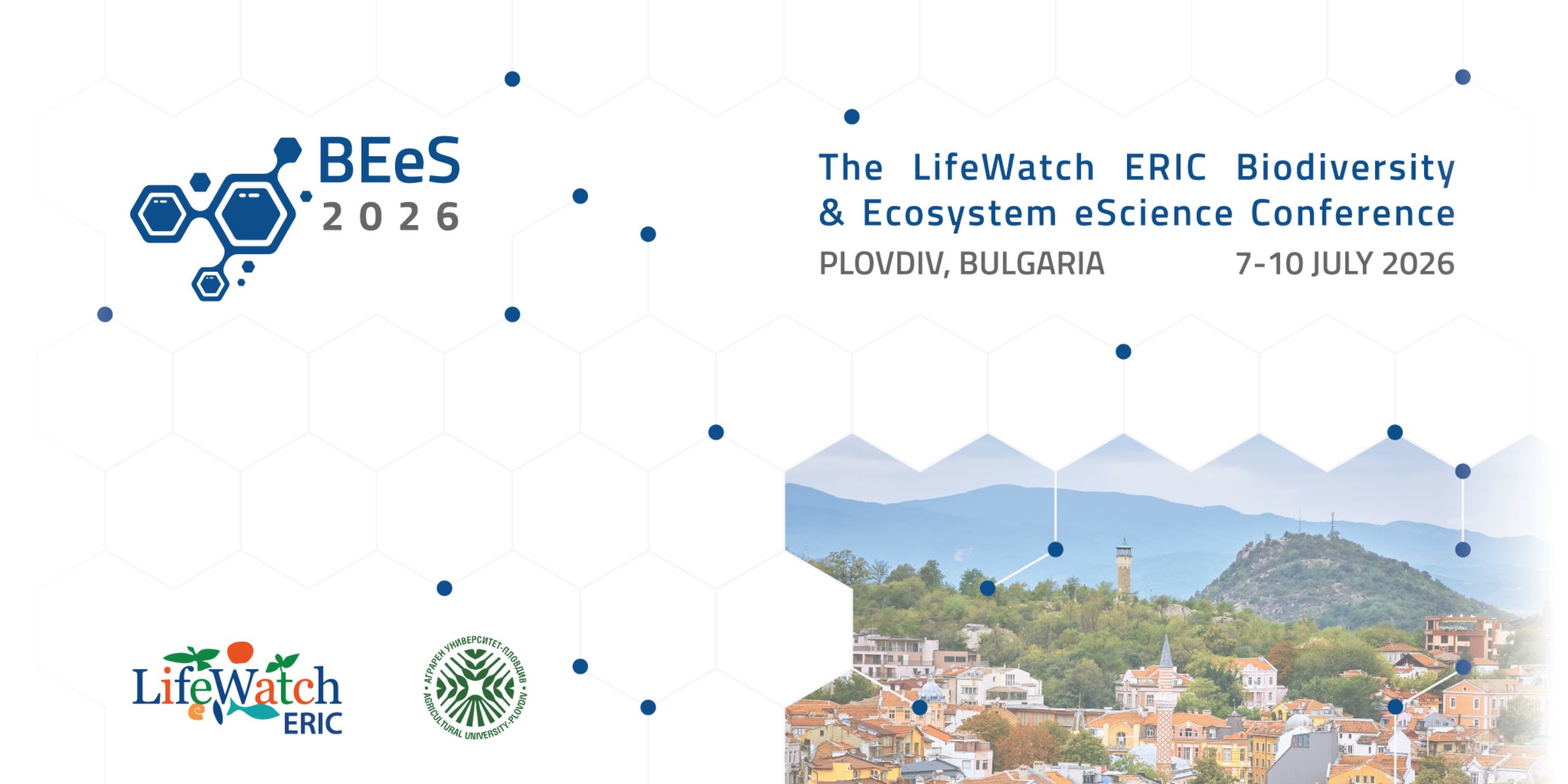
BEeS 2026 - Call for abstracts
The call for abstracts of the LifeWatch ERIC BEeS 2026 is now open. The conference offers a selected range of topics for which abstracts for long and short oral presentations can be submitted. We aim at collecting contributions exploring the topics listed below.
How to submit an abstract
Click on the button below, create your profile and activate your account. After logging in, you will be redirected to your personal area, where you can click on “+ New Abstract” and fill in the form. Each abstract should not be longer than 250 words.
Submission opening: 27 February 2026
Submission deadline: 15 May 2026
Session topics
This session focuses on integrated “whole-system” approaches where biodiversity, ecosystem functioning, and the health of people, animals, and plants are treated as interdependent. The emphasis is on connecting evidence across scales, from local monitoring to broader risk assessment, so that early warnings and response options can be designed coherently. It also highlights how LifeWatch ERIC can support this integration through shared data, interoperable services, and reusable workflows that enable cross-sector analysis. The goal is practical, decision-relevant knowledge that can be traced back to transparent data and methods, and re-used across regions and use cases.
This session addresses how metagenomics, DNA metabarcoding, and eDNA enable rapid biodiversity assessment from environmental samples, including in hard-to-sample marine settings. It highlights how these methods support ocean health monitoring, detection of ecological change, and evidence for sustainable management, including through longitudinal sampling that captures seasonality and climate-linked shifts. A key focus is the enabling infrastructure, standardised sampling and metadata, robust compute environments for large-scale analysis, and accessible platforms such as Galaxy instances to democratise workflows. The session also links these advances to coordinated monitoring networks that can scale from local surveys to broader, comparable assessments.
Animal traits, behaviour and bio-tracking explore how traits and movement patterns shape population dynamics, species interactions, and ecosystem processes, and how these can be measured using modern biologging and tracking methods. The session aims to link trait and movement data to scalable analytics and reproducible workflows, ensuring results remain comparable across studies and regions. It also supports stronger integration of movement and behaviour evidence into broader biodiversity assessments, including conservation planning and management evaluation. Through the LifeWatch ERIC Animal Movement and Biologging community, methods, data practices, and shared outputs can be developed, exchanged, and improved collaboratively.
This session covers smart and increasingly automated observation approaches for biodiversity monitoring, ranging from aerial observations to eDNA, and spanning survey design, data curation, and analysis. It emphasises practical barriers such as time-intensive fieldwork and complex data pipelines, and how automation and AI can help scale monitoring while improving consistency. A strong theme is FAIR data practice and the move towards integrated monitoring systems that can feed policy-relevant indicators and digital twin-style applications. The aim is to turn heterogeneous monitoring streams into usable, interoperable evidence products that can be updated over time.
This session links habitat mapping and biogeographic analysis to understand how biodiversity patterns vary across space, shaped by gradients such as latitude, elevation, isolation, and habitat area. It focuses on translating spatial evidence into practical conservation and planning outputs, including prioritisation, comparability of assessments, and tracking change over time. The emphasis is on integrating multiple data sources and methods to produce consistent, reusable habitat layers and regional syntheses that can be updated as new data arrive. Using shared services and reproducible workflows, the session supports scalable analyses that remain transparent, comparable across regions, and directly useful for conservation strategy and management evaluation.
This session addresses how climate change affects biodiversity and ecosystem processes across scales, from individual life cycles and energetics to population distributions, ecological networks, and ecosystem services. It emphasises turning these complex responses into structured, synthesised evidence that can support adaptation and mitigation strategies. It also highlights the role of LifeWatch ERIC communities in aligning data, models, and workflows so that change detection and attribution become more robust and comparable. The intended outcome is a clearer, evidence-based understanding of ecological responses that can be communicated in policy-relevant forms.
This session focuses on restoration as an evidence-driven process, linking monitoring, diagnosis of pressures, and evaluation of recovery trajectories in marine and freshwater systems. It highlights how molecular tools, including eDNA and broader omics, can complement classical monitoring by detecting biodiversity change, stress signals, and community shifts earlier and at larger scales. The goal is to connect restoration actions to measurable ecological outcomes, supported by reproducible workflows and transparent data management. In practice, this means building serviceable pipelines that can track restoration performance over time and support comparable reporting across sites.
This session addresses taxonomy as the backbone of biodiversity knowledge, enabling reliable naming, linking, and integration of observations and datasets. It focuses on assessing the state of taxonomy-related services, how well they align with community needs, and what priorities should guide further integration and improvement within LifeWatch ERIC. Strong emphasis is placed on usability and interoperability, so taxonomic references can be applied consistently across biodiversity analyses that depend on reliable taxonomic references.
This session focuses on making biodiversity and ecosystem data easier to discover, interpret, and reuse through semantics, shared vocabularies, and interoperable knowledge structures. It highlights the role of core and domain ontologies and curated reference resources to reduce ambiguity and improve machine-readability, which is essential for scalable workflows and integration across disciplines. A practical emphasis is placed on data curation as an enabling layer, ensuring metadata quality and consistent interpretation across platforms and services. The goal is to turn distributed resources into an interoperable knowledge space that supports synthesis, modelling, and decision support.
This session focuses on soil biodiversity and microbiology as key determinants of ecosystem functioning, resilience, and sustainable land management, including climate-relevant processes. It emphasises combining biodiversity observations, microbial and functional indicators, and reproducible analytics so results can be compared across sites and monitoring schemes. In line with LifeWatch ERIC’s broader service approach, the session is oriented toward building shared pipelines and data practices that help translate soil evidence into usable metrics for management and policy. The intended output is actionable insight on soil system status and change, grounded in transparent data and methods.
This session focuses on using ecological and biodiversity models to turn data into testable understanding, scenarios, and decision-relevant insights across ecosystems. It emphasises transparent, reproducible modelling workflows that integrate observations, environmental drivers, and uncertainty, so results can be compared and updated over time. A key theme is interoperability, linking models with shared data resources and digital research environments to support collaboration across teams and regions. The session aims to move from isolated modelling exercises to reusable, service-oriented approaches that can inform conservation planning, risk assessment, and evaluation of management actions.