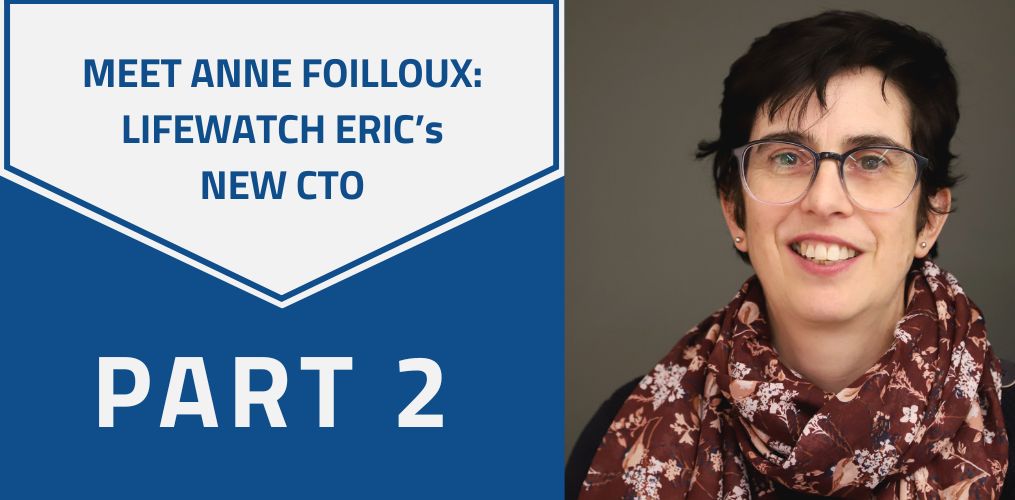
In November 2025 LifeWatch ERIC welcomed its new Chief Technology Officer, Anne Fouilloux, to guide its technological strategy and ensure alignment with global advances in biodiversity and ecosystem research across Europe.
In this second part of our two-part interview, we asked her about her vision on how to turn data into impact, and how to break down silos and enable cross-discipline, cross-border collaboration.
If you missed it, you can read Part 1 here, where we focused on Anne’s experiences that shaped her work, real-life examples from her previous roles, and how these influence her approach as CTO.
Anne, you once mentioned on social media that we ‘turn data into impact for a better world’. How do you think we can achieve this?
“We strengthen the connections between research and real-world conservation through three key areas:
- Making data trustworthy through provenance: At ECMWF, traceability built trust. Users could trace exactly which observations influenced forecasts. Biodiversity faces similar challenges with field observations, satellite imagery, eDNA, and citizen science. When conservation managers make decisions, they need confidence in their data’s origins and quality. A lot of very good work is done at LifeWatch ERIC on FAIR data management and we need to pursue this effort, not only for datasets but for our tools and workflows. FAIR Digital Objects is becoming increasingly mature and I believe it will help LifeWatch ERIC a lot in its operation. We are distributed by nature and we need to interoperate with others but also with ourselves.
- Serving diverse communities effectively: Through Galaxy, Pangeo, and my current FAIR2Adapt project, I learned that accessible infrastructure matters as much as powerful infrastructure. We should strategically design systems that serve everyone, from citizen scientists to policymakers, with clear purposes and sustainable approaches. However, there is no single interface or tool that can fit everyone. We need to be able to build bespoke tools and interfaces in a streamlined manner.
- Creating feedback loops: Real impact comes from connecting observation to understanding to action to learning. Can we trace conservation outcomes back to the research that enabled them? That continuous improvement cycle turns data into lasting impact for biodiversity and our planet. To get feedback, we need tools to measure, ask questions and collect answers in a way that is not disruptive to end-users. We cannot collect everything automatically but we should try to collect as much relevant information as possible, while preserving people’s privacy. We need to present transparently how we do and measure our progress and/or correct our mistakes.”
How does your mission evolve in the European Research Infrastructure landscape?
“European RIs work at a unique scale that opens exciting strategic opportunities.
- From distributed to coordinated: LifeWatch ERIC’s federated nature across member states distributed geographically is a tremendous strength. It makes us more resilient, more fault tolerant and more importantly, we see the world from different angles and cultures. It can help us to increase the interoperability of our e-infrastructure. My experience with distributed governance, building frameworks that enable innovation while maintaining interoperability, helps harness this diversity. We can align technology efforts while respecting each center’s autonomy and expertise.
- From independence to strategic partnership: My collaboration work with ELIXIR for leveraging their tooling and workflow tools, EGI for computing, and through EOSC shows how RIs complement each other. I want to help LifeWatch ERIC identify where we should lead, where we should partner, and where we should leverage others’ strengths, especially as we want to use and prepare for AI, quantum computing, and many other emerging technologies that will transform biodiversity research and increase data and compute sovereignty.
- From operations to strategic impact: securing sustainable infrastructure funding and building capacity across member states ensures that expertise is distributed throughout our network. I’ve learned from organisations such as ECMWF, NeIC, and Sigma-2 how to plan next-generation infrastructure while maintaining current operations, and I’m excited to apply these lessons at LifeWatch ERIC. The ‘e-’ is clearly an advantage here, and we need to leverage it.
- From capability to transformation: LifeWatch ERIC has impressive scientific foundations, strong ICT expertise and dedicated people across our member states. My goal is helping us work strategically together, maximising our collective impact for biodiversity conservation, climate adaptation, and the urgent environmental challenges ahead. The opportunity is clear: build on our strong foundation to create digitally integrated infrastructure that serves researchers, practitioners, and policymakers across Europe. I’m ready to take on this challenge and contribute to that mission.”
We thank again Anne Fouilloux for the insightful answers and we wish her the best of luck in her new role!