Biodiversity and planetary health: presenting the Crete Declaration at the University of Lisbon

Doctoral Programme on Planetary Health

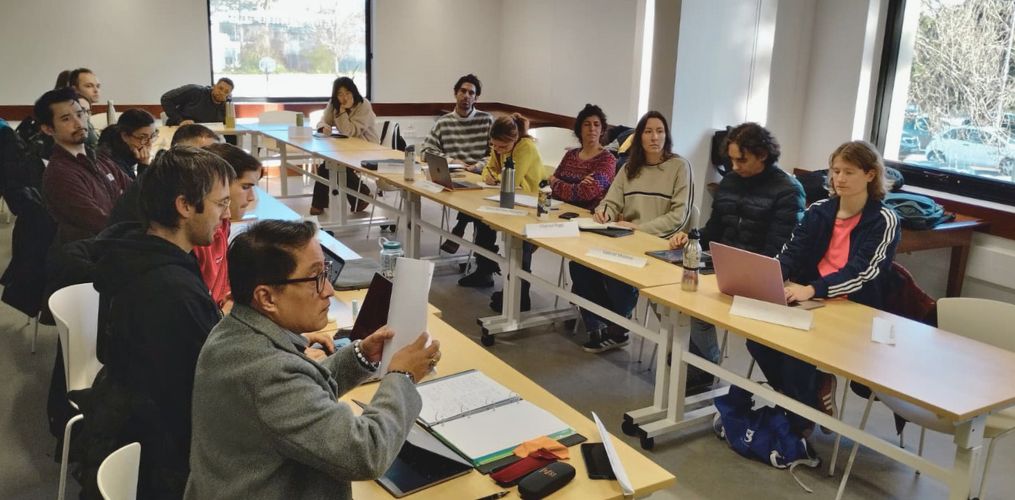
On 5th January 2026, LifeWatch ERIC’s CEO Christos Arvanitidis delivered an online presentation for the 4th Course of the Doctoral Programme in Planetary Health, organised by the University of Lisbon.
The 40-minute presentation titled “From Biodiversity to Planetary Health: Enabling Science for Societal Transformation” focused on the link between the course’s holistic approach and the “Crete Declaration” approach.

The Crete Declaration is a Declaration of Intent signed between LifeWatch ERIC and a group of Research Infrastructures and European projects and organisations. It takes its name from Heraklion, Crete, where the signing took place in the summer of 2025, during the BEeS 2025 Conference.

With this Declaration, the signatories committed to advance the One Health approach, promoting cross-domain research and integrated solutions. The core premise supporting this ecological-social continuum, which also underlies the common thread of the University of Lisbon Course, is that to address Planetary Health through the current poly-crisis, we need a concerted action.

The Doctoral Programme, in fact, aims at preparing students to tackle complex issues that cross ecological and societal boundaries. The three modules of the course (Adaptation; Transformation; Into Action) address critical global challenges at the intersection of health, environmental, social and political science, with the aim of fostering discussion and critical thinking through a wide variety of topics.

This was central to Christos’ intervention, proposing suggestions on how to turn biodiversity science into action: an ambition that requires a shift from fragmentation to integration of disciplines, data silos, and policy gaps.
An insightful round of discussions with the students followed the presentation, providing a mutual exchange that may inspire both the students and the future work of the Crete Declaration.

If you would like to contribute your perspective to the Crete Declaration, you can add your name here: https://www.lifewatch.eu/crete-declaration. We will inform you about future developments. Are you interested in applying for the Doctoral Programme in Planetary Health? The first round of applications runs from 12 January to 20 February 2026. All details are available here: https://www.ulisboa.pt/planetary-health-studies.

Policy Relevance and Uptake

  • End of May 2026 – Policy-brief to demonstrate the application of habitat-based mapping in supporting EU strategies (e.g., Biodiversity Strategy, Nature Restoration Law).

Mapping user requirements

  • End of January 2025 – Catalogue of services already available in LifeWatch ERIC or research lines addressing ecological responses to climate change;
  • February 2025 (TBD) – Online working table on setting priorities, timeline and milestones for the mapping service and model requirements by scientists and science stakeholders.
Greece

The Greek National Distributed Centre is funded by the Greek General Secretariat of Research and Technology and is coordinated by the Institute of Marine Biology, Biotechnology and Aquaculture of the Hellenic Centre for Marine Research, in conjunction with 47 associated partner institutions.

To know more about how Greece contributes to LifeWatch ERIC, please visit our dedicated webpage.

Italy

The Italian National Distributed Centre is led and managed by the Italian National Research Council (CNR) and is coordinated by a Joint Research Unit, currently comprising 35 members. Moreover, Italy hosts one of the LifeWatch ERIC Common Facilities, the Service Centre.

To know more about how Italy contributes to LifeWatch ERIC, please visit our dedicated webpage.

Netherlands

The Dutch National Distributed Centre is hosted by the Faculty of Science of the University of Amsterdam. Moreover, The Netherlands hosts one of the LifeWatch ERIC Common Facilities, the Virtual Laboratory and Innovation Centre.

To know more about how The Netherlands contributes to LifeWatch ERIC, please visit our dedicated webpage.

Portugal

The Portuguese National Distributed Centre is managed by PORBIOTA, the Portuguese e-Infrastructure for Information and Research on Biodiversity. Led by BIOPOLIS/CIBIO-InBIO – Research Centre in Biodiversity and Genetic Resources, PORBIOTA connects the principal Portuguese research institutions working in biodiversity.

To know more about how Portugal contributes to LifeWatch ERIC, please visit our dedicated webpage.

Slovenia

The Slovenian National Distributed Centre is led by the Research Centre of the Slovenian Academy of Sciences and Arts (ZRC SAZU). It focuses on the development of technological solutions in the field of biodiversity and socio-ecosystem research.

To know more about how Slovenia contributes to LifeWatch ERIC, please visit our dedicated webpage.

Spain

The Spanish National Distributed Centre is supported by the Ministry of Science, Innovation and Universities, the Regional Government of Andalusia and the Guadalquivir River Basin Authority (Ministry for Ecological Transition-MITECO). Moreover, Spain is the hosting Member State of LifeWatch ERIC, the location of its Statutory Seat & ICT e-Infrastructure Technical Office (LifeWatch ERIC Common Facilities). 

To know more about how Spain contributes to LifeWatch ERIC, please visit our dedicated webpage.

Bulgaria

The Bulgarian National Distributed Centre is represented by the  Agricultural University-Plovdiv.

To know more about how Bulgaria contributes to LifeWatch ERIC, please visit our dedicated webpage.

Implementing services

  • End of January 2025 – Internal distribution of a questionnaire on the most used/relevant model resources in the WG member research activity;
  • February 2025 (TBD) – Online working table on setting priorities, timeline and milestones for the mapping service and model requirements by scientists and science stakeholders.

Knowledge Exchange and Capacity Building

  • End of December 2025 – Create a shared repository of guidance documents, tools, templates, and data resources accessible to WG members and broader communities.

Organising WG workshops and conferences

  • End of January 2025 – Setting priority research lines and contributions to the BEeS 2025 LifeWatch Conference for the session on the “Ecological responses to climate change”;
  • March/April 2025 (TBD) – Workshop ‘Ecological modelling and eco-informatics to address functional responses of biodiversity and ecosystems to climate change’ co-organised with the University of Salento;
  • 30 June – 3 July 2025 – Participation to LifeWatch 2025 BEeS Conference on “Addressing the Triple Planetary Crisis”.

Fund raising

  • End of January 2025 – Establishing a WG Committee on scouting project application opportunities and fundraising.

Meetings, Webinars, International Conferences & Networking (2025/2026)

  • Organising and participating at discussions on emerging technologies in biodiversity monitoring;
  • Organising webinars on machine learning, eDNA analysis, and automated data collection;
  • Fostering collaboration between researchers, technologists, and decision-makers.

Collaborative Research & Case Studies (2025/2026)

  • Conducting pilot projects to test new monitoring methods;
  • Publishing scientific and popular science papers and reports on advancements in biodiversity assessment.

Data Standardisation & FAIR Principles Implementation (2025/2026)

  • Developing best practices for data curation and sharing;
  • Ensuring that biodiversity data aligns with FAIR (Findable, Accessible, Interoperable, Reusable) standards.

Development of VREs for Ecosystem Simulation (2026)

  • Creating virtual models of ecosystems to predict environmental changes;
  • Enhancing conservation strategies through AI-driven simulations.

Mapping Requirements and Gap Analysis

  • End of December 2025 – Catalogue of services already available in LifeWatch ERIC or research lines Ecosystem services mapping.

Methodological Alignment and Innovation

  • End of January 2026 – Online working table on mapping standards, classification systems, and indicators across members;
  • End of January 2026 – Catalogue of advanced techniques (e.g., remote sensing, GIS modelling, and machine learning) for scalable, habitat-based ecosystem service mapping;
  • End December 2026 – Methodological framework to support methodological innovation through joint development and testing of mapping approaches, especially linking ecosystem service supply and demand.
Belgium

The Belgian National Distributed Centre makes varied and complementary in-kind contributions to LifeWatch ERIC. These are implemented in the form of long-lasting projects by various research centres and universities distributed throughout the country and supported by each respective political authority.

To know more about how Belgium contributes to LifeWatch ERIC, please visit our dedicated webpage.