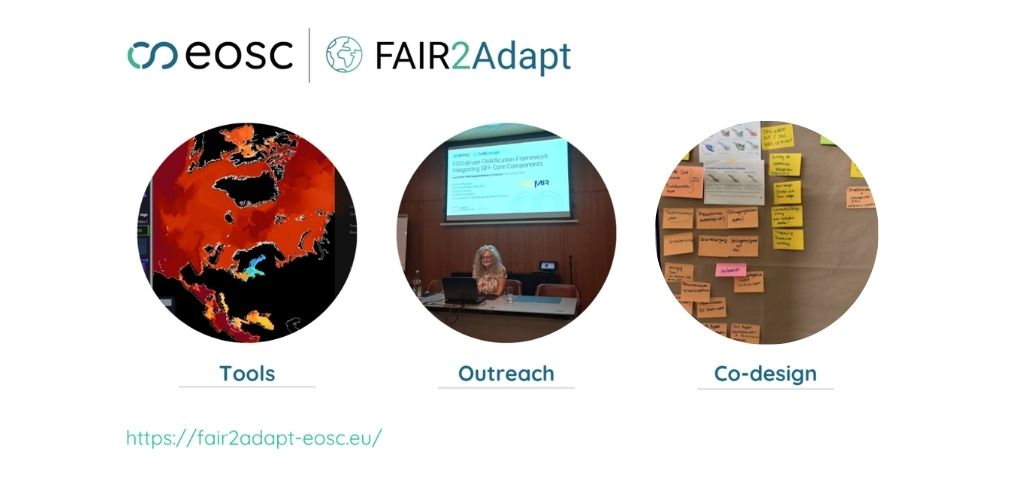
The FAIR2Adapt project hasn’t stopped over the summer, and continued to follow its programme of case study development and community engagement, coordinated by LifeWatch ERIC.
A fourth webinar in the FAIR Solution series was launched, presented by Tina Odaka (Ifremer), demonstrating how high-resolution coastal ocean models from the RiOMar project can be made accessible and reusable through a FAIR dashboard built on the I-ADOPT framework (full webinar series here: https://www.youtube.com/@EOSCFair2Adaptproject).
This summer also brought a notable demonstration of FAIR infrastructure in action: the same FAIR dashboard developed for RiOMar was successfully reused, without modification, for FAIR2Adapt’s Arctic radionuclide case study. This is a concrete example of reusing FAIR Digital Objects across scientific domains, demonstrating exactly the kind of reusable-by-design infrastructure LifeWatch ERIC aims to build for biodiversity and ecosystem data.
In parallel, the project team held a co-design workshop with the weADAPT community – a global knowledge exchange platform for climate change adaptation – to shape two AI-powered tools currently in development: an AI chatbot for exploring the platform’s knowledge base, and an AI-assisted tagging and metadata system.
Towards the end of the summer, FAIR2Adapt partners brought the project’s work to two major events.
Barbara Magagna (GO FAIR Foundation, FAIR2Adapt) participated in a full-day workshop at the ECCB 2026 SIB Communities Day in Geneva, where experts from ELIXIR Europe, CODATA, and SIB Swiss Institute of Bioinformatics compared FAIRification frameworks and stress-tested cross-framework integration across biodiversity, health, and AI domains. Held alongside the European Congress of Conservation Biology, the session put FAIR2Adapt’s approach directly in front of the biodiversity and conservation community that is LifeWatch ERIC’s own core audience, reinforcing alignment between FAIR2Adapt’s framework and LifeWatch ERIC’s FAIRification work. The groups agreed to position their frameworks as complementary components of a unified FAIR ecosystem rather than competing standards.
Lauren Snyder (TIB) presented the TIB Knowledge Loom – an Open Science digital library used in FAIR2Adapt – to the German NFDI (National Research Data Infrastructure) community in a one-hour webinar. Attendees learned how the Knowledge Loom supports the verification and reuse of scientific knowledge, and were among the first to see the freshly launched submission system that allows researchers to publish their work free of charge. Watch the recording here: https://www.youtube.com/live/4CR1zDBB2Go
Visit FAIR2Adapt for more information: https://fair2adapt-eosc.eu/index.php/2026/09/17/fair2adapt-enjoyed-a-busy-summer-advancing-fair-tools-for-climate-change-adaptation