Anne Fouilloux, LifeWatch ERIC’s CTO, attended the TDWG 2026 Conference and participated in the panel discussion “Strengthening resilience in biodiversity data infrastructures: From practice to global coordination”, on Tuesday 22 September.
The discussion, moderated by Sharif Islam (Naturalis Biodiversity Center, Netherlands) and Giuditta Parolini (Museum für Naturkunde, Germany), started from the question of how scientific collaboration can move beyond “bilateral” technical integrations, to shift toward a coordinated biodiversity data ecosystem.
Moving from data siloed across specialised infrastructures like DISSCo, GBIF, BHL, eLTER, ELIXIR, and LifeWatch ERIC, and using the DiSSCo-GBIF collaboration as a starting point, the session invited participants to explore grounds for collaborations across infrastructures.
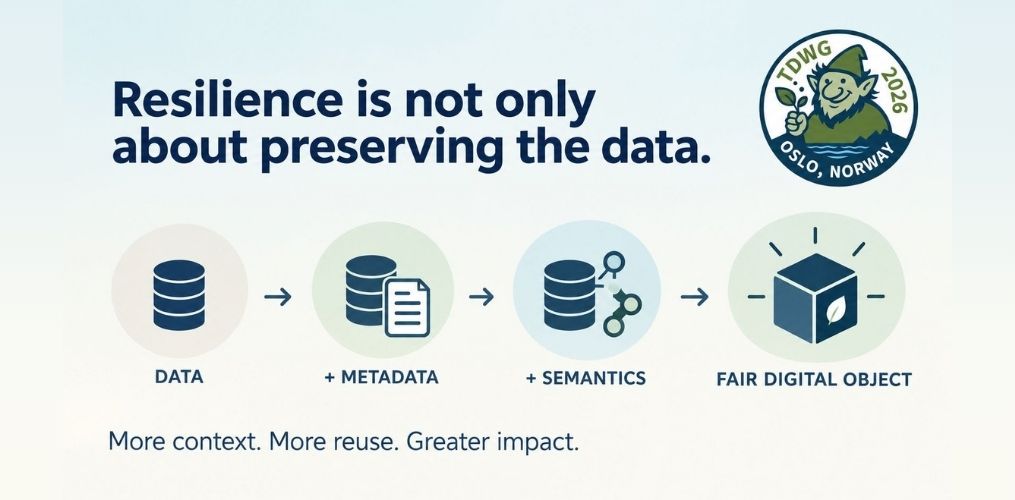
“A data infrastructure that stops at “data” is incomplete”, commented Anne Fouilloux on her participation in a social media post published after the event. She highlighted that resilience is not only about preserving data, but also about preserving the context that makes data understandable, trustworthy and reusable, including provenance, metadata, methods, workflows and the services that support their use.
She also pointed to the role of FAIR Digital Objects (FDOs) in this context, describing them as a way of encapsulating data together with the information needed to understand, trust and reuse it, while preserving this context as data are transformed and combined. According to Dr. Fouilloux, this represents a continuation of a broader trajectory in biodiversity data infrastructures: as standards, ontologies and mappings have progressively reduced the burden of data curation and reconciliation placed on users, FDOs can contribute to extending this principle by making interoperability and reuse increasingly infrastructure-driven rather than user-driven.
A key challenge, she observed, is now to make these concepts accessible beyond communities already familiar with FDOs, provenance and interoperability. The discussion brought together perspectives from several European and international biodiversity data infrastructures and highlighted the importance of moving from individual technical integrations towards shared approaches that can strengthen the resilience and sustainability of the wider biodiversity data ecosystem.
The LifeWatch Italy team also attended the conference to discuss about National Biodiversity Data Infrastructures, and infrastructure-driven solutions:
Andrea Tarallo presented the poster “Assessing the maturity and sustainability of the LifeWatch Italy Data Portal using the Data Infrastructure Maturity Profile“, during the Workshop “Strengthening National Biodiversity Data Infrastructures through International Coordination”, co-organised by Anton Güntsch, David Fichtmueller, Tanja Weibulat, Victor Heijke, Andrea Tarallo, on 22 September.
Cristina di Muri presented “Infrastructure-driven solutions to strengthen semantic interoperability in ecology”, in the session “Semantic Interoperability and Standards Infrastructure” moderated by Ben Norton.
Jessica Titocci presented “Traits Thesaurus: towards semantic harmonisation of FAIR trait-based data on aquatic organisms”, in the session “AI-Readiness Metrics and Metadata for Biodiversity Data”, organised by and Yasin Bakış, Cem Meydan.
For more information about the TDWG 2026 Conference, visit: https://www.tdwg.org/conferences/2026/#