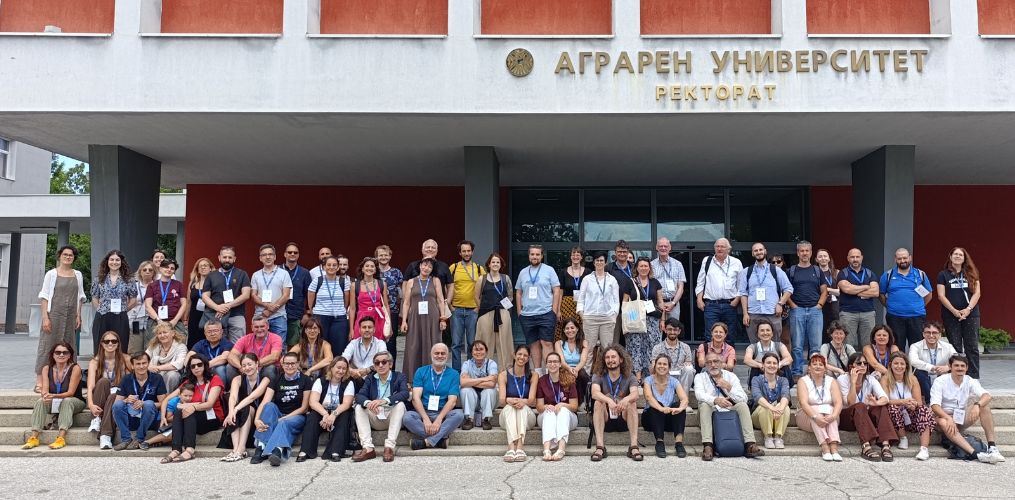
From 7 to 10 July, the biodiversity and ecosystem research community gathered in Plovdiv, Bulgaria, for LifeWatch ERIC’s Biodiversity and Ecosystem eScience Conference (BEeS 2026), bringing together 216 registrants from 28 countries (and co-located with LifeWatch ERIC’s General Assembly).
Across four days of scientific exchange, discussions, and hands-on activities, researchers and infrastructure experts explored how digital technologies (including artificial intelligence) have the potential to shape the future of biodiversity and ecosystem research.
As LifeWatch ERIC’s flagship event, each edition of BEeS is hosted by one of its Distributed Centres, and this year the spotlight was on LifeWatch Bulgaria, with the conference taking place at the Agricultural University – Plovdiv (AUP). The event opened with welcoming remarks from AUP Rector Prof. Boryana Ivanova, and Vice-rector Prof. Dimo Atanasov, alongside Prof. Alberto Basset, Interim Director of LifeWatch ERIC’s Service Centre, and Christos Arvanitidis, LifeWatch ERIC’s CEO.
The expertise of the Bulgarian Distributed Centre inspired many of this year’s conference topics, and provided the ideal setting for the official launch of the LifeWatch ERIC’s Thematic Service Working Group on Agroecology. During this pre-conference session on 7 July, the Working Group members worked together to align agroecological priorities and digital services, and to define the future roadmap and action areas of the WG.
The pre-conference programme also included updates from the other Thematic Services Working Groups: an open discussion with coordinators presenting their current activities and exploring future priorities.
From 8 to 10 July, the conference moved into its main scientific programme with 5 keynote sessions from Prof. Tatyana Bileva (Agricultural University Plovdiv), Dr. Dessislava Dimitrova (IBER-BAS), Prof. Carl Beierkuhnlein (University of Bayreuth/Universidad de Granada), Prof. Vladislav Popov (Agricultural University Plovdiv) and Dr. Anne Fouilloux (LifeWatch ERIC). The Key Notes focused on biodiversity conservation, responses to climate change, agroecology, as well as new frontiers for eScience. The speakers bios and summaries of each keynote are available here: https://www.lifewatch.eu/bees-2026-meet-the-speakers.
The contributed programme featured 70 talks distributed over several parallel sessions covering 12 scientific topics (the Book of Abstracts will be published and announced soon!). These contributions showcased the wide breadth and ranges of application of current biodiversity and ecosystem research, from ecological and environmental modelling, to data infrastructures and emerging digital tools. Presentations slides (only those where permission for publication has been granted by the authors) are available online on this page: https://www.lifewatch.eu/bees-2026-presentations.
Beyond the contributed sessions, BEeS 2026 offered opportunities for practical learning and community engagement. Participants joined 6 Masterclasses, 11 Training Sessions, a documentary screening, networking sessions, and the BioBEeS, a citizen science bioblitz dedicated to documenting Bulgaria’s animal, plant and fungal biodiversity. The initiative, launched by LifeWatch Italy, concluded during the conference Social Dinner with the announcement of the two winners: Lorenzo Braga and Sara Strah.
Acting as a platform for international collaboration in biodiversity and ecosystem research, BEeS 2026 has raised many positive comments among participants. One of them, shared in the post-conference feedback read: “This conference demonstrated that to save nature, we must first understand it in detail. Thanks to platforms like LifeWatch ERIC, science now has the digital senses to decipher ecological crises and offer real, timely technological solutions”.
We are already looking forward to the next edition. Until then, stay tuned for updates!