The LifeWatch ERIC BEeS Conference features seven different topic sessions, for which over 65 abstracts have been submitted.
Our Abstract Book has just been released. Browse it below.
Home | BEeS 2023
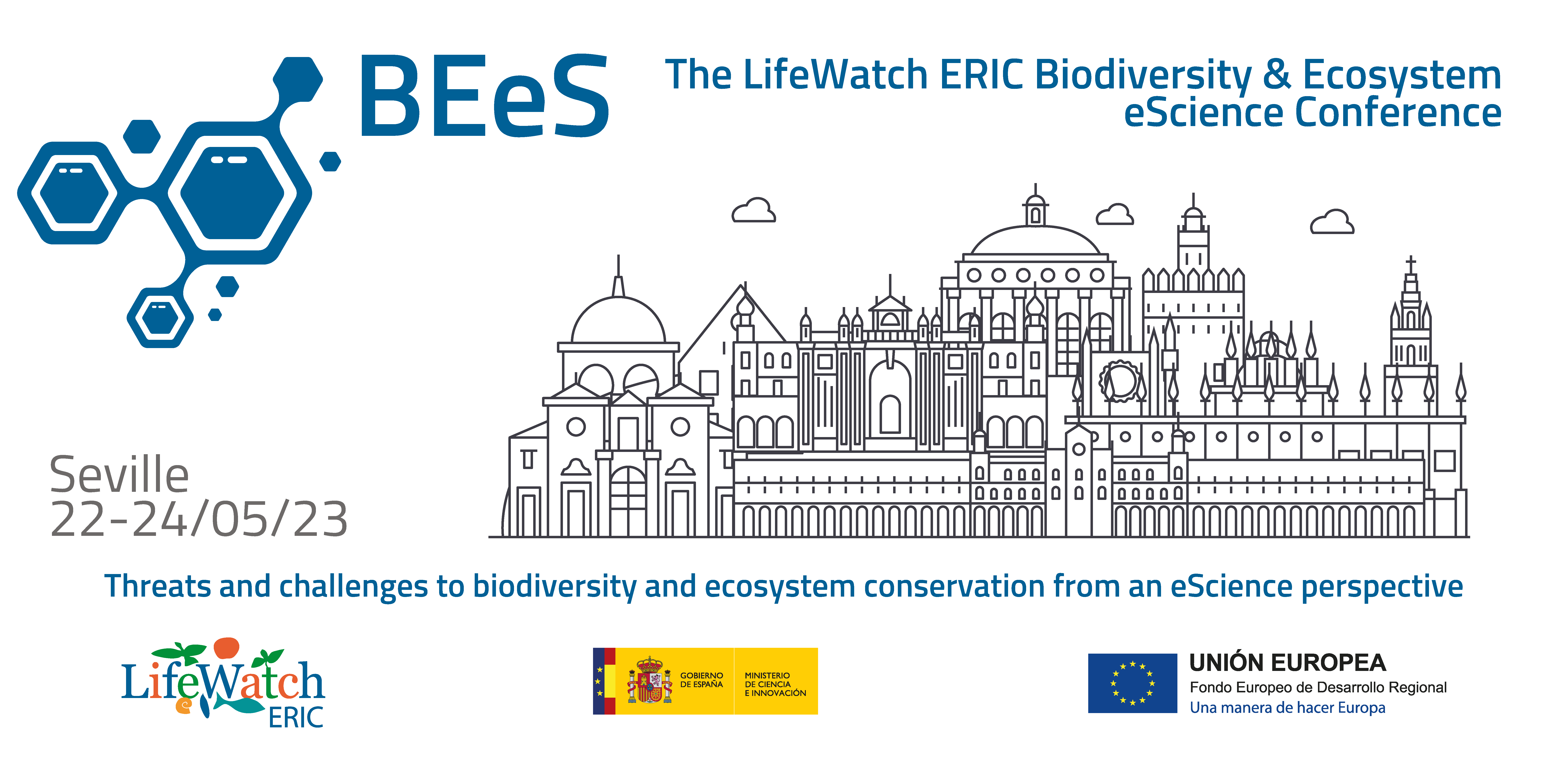
Threats and challenges to biodiversity and ecosystem conservation from an eScience perspective.
Participation in the Conference is free.
The LifeWatch ERIC BEeS Conference features seven different topic sessions, for which over 65 abstracts have been submitted.
Our Abstract Book has just been released. Browse it below.
We use cookies to help you navigate efficiently and perform certain functions. You will find detailed information about all cookies under each consent category below.
We also use third-party cookies that help us analyse how you use this website, store your preferences, and provide the content that is relevant to you. These cookies will only be stored in your browser with your prior consent.
You can choose to enable or disable some or all of these cookies but disabling some of them may affect your browsing experience.
Permanent activity
Coordinate collaboration among Distributed Centres, Living Labs and research communities to support the development of agroecology services within LifeWatch ERIC;
End of 2027
Improve comparability of research outputs, accelerate adoption of services, and foster co-created solutions for researchers, farmers, advisors and policy makers.
Permanent activity
Facilitate joint initiatives, project proposals and knowledge exchange to ensure sustained service development and long-term impact.
June 2026
Deployment of EDDAn data space for Agrifood sector in Andalusia; Adaptation of TITAN workflow platform and related KHAOS tools to serve as a reproducible, trustworthy analysis layer within EDDAn Data Space;
September 2026
An AGROSERV TransNationalAccess project is currently underway by LifeWatch ERIC and AnaEE ERIC to develop a VREfA (Virtual Research Environment for Agroecology). The project, led by UPO, will support the biophysical analysis of agroecosystems that are transitioning to agroecological management practices.
Permanent activity
Increase knowledge on ecological processes in agroecosystems, considering both relevant spatial scales and long-term changes.
End of 2027
Promote the advancement of Landscape Agroecology, exploring new ways of functional integration of different land and livestock uses to increase territorial efficiency and generate landscape mosaics well-endowed with biodiversity and ecosystem services.
End of 2027
Contribute to the design of agroecological food systems at local and bioregional levels to meet population food demands.
End of 2028
Research on the contribution of agroecological management to combating climate emergencies, both in terms of mitigation (sequestration) and adaptation to adverse climatic conditions at both farm and landscape level.
The Bulgarian National Distributed Centre is represented by the Agricultural University-Plovdiv.
To know more about how Bulgaria contributes to LifeWatch ERIC, please visit our dedicated webpage.
The Spanish National Distributed Centre is supported by the Ministry of Science, Innovation and Universities, the Regional Government of Andalusia and the Guadalquivir River Basin Authority (Ministry for Ecological Transition-MITECO). Moreover, Spain is the hosting Member State of LifeWatch ERIC, the location of its Statutory Seat & ICT e-Infrastructure Technical Office (LifeWatch ERIC Common Facilities).
To know more about how Spain contributes to LifeWatch ERIC, please visit our dedicated webpage.
The Slovenian National Distributed Centre is led by the Research Centre of the Slovenian Academy of Sciences and Arts (ZRC SAZU). It focuses on the development of technological solutions in the field of biodiversity and socio-ecosystem research.
To know more about how Slovenia contributes to LifeWatch ERIC, please visit our dedicated webpage.
The Portuguese National Distributed Centre is managed by PORBIOTA, the Portuguese e-Infrastructure for Information and Research on Biodiversity. Led by BIOPOLIS/CIBIO-InBIO – Research Centre in Biodiversity and Genetic Resources, PORBIOTA connects the principal Portuguese research institutions working in biodiversity.
To know more about how Portugal contributes to LifeWatch ERIC, please visit our dedicated webpage.
The Dutch National Distributed Centre is hosted by the Faculty of Science of the University of Amsterdam. Moreover, The Netherlands hosts one of the LifeWatch ERIC Common Facilities, the Virtual Laboratory and Innovation Centre.
To know more about how The Netherlands contributes to LifeWatch ERIC, please visit our dedicated webpage.
The Italian National Distributed Centre is led and managed by the Italian National Research Council (CNR) and is coordinated by a Joint Research Unit, currently comprising 35 members. Moreover, Italy hosts one of the LifeWatch ERIC Common Facilities, the Service Centre.
To know more about how Italy contributes to LifeWatch ERIC, please visit our dedicated webpage.
The Greek National Distributed Centre is funded by the Greek General Secretariat of Research and Technology and is coordinated by the Institute of Marine Biology, Biotechnology and Aquaculture of the Hellenic Centre for Marine Research, in conjunction with 47 associated partner institutions.
To know more about how Greece contributes to LifeWatch ERIC, please visit our dedicated webpage.
The Belgian National Distributed Centre makes varied and complementary in-kind contributions to LifeWatch ERIC. These are implemented in the form of long-lasting projects by various research centres and universities distributed throughout the country and supported by each respective political authority.
To know more about how Belgium contributes to LifeWatch ERIC, please visit our dedicated webpage.