Fostering Innovation with the European Commission and Universities for Regional Development

regional development

On Friday 2 December, European experts debated in the Auditorium of the University of Seville about the contribution of the university to regional development and how the promotion of innovation can benefit the double ecological and digital transition. The seminar, organised by the Joint Research Centre (JRC) of the European Commission and the universities of Seville and Pablo de Olavide, served as a stage for the exchange of knowledge on how the connection between universities and the other actors in the innovation system is essential to tackle challenges such as climate change, digitisation or water scarcity.

The Minister of University, Research and Innovation of the Junta de Andalucía, José Carlos Gómez Villamandos; the director of the JRC in Seville, Mikel Landabaso; and the rectors of the University of Seville and the Pablo de Olavide University, Miguel Ángel Castro Arroyo and Francisco Oliva Blázquez, participated in the seminar called ‘The contribution of the university to regional development through the promotion of innovation’.

In particular, examples were analysed of how collaboration between companies and universities is a characteristic of the most advanced regions in terms of innovation and job creation. In addition, the role of universities in the implementation of regional economic transformation strategies was discussed. For this, experts intervened such as Francisco Solé, vice president of the CYD Foundation; Luc Soete, former Chancellor of Maastricht University and co-chair of the S4 Scientific Commission; Koen Jonkers, editor-in-chief of the JRC; Karel Haegeman, team leader at JRC; Johan Stierna, JRC Lead Scientist; Antonia Jiménez, Vice-Rector for Research, Transfer and Doctorate at the Pablo de Olavide University, and Felipe Rosa, Vice-Rector for Knowledge Transfer at the University of Seville.

LifeWatch ERIC, which sets an example of promoting innovation through agreements with research centres and universities inside and outside Europe, attended this seminar. Juan Miguel González Aranda, LifeWatch ERIC Chief Technology Officer and Common Facility in Spain-ICT Core Director, reached out to the heads of the JRC and the main universities in Seville to expand cooperation in projects already underway.

The Councillor for University, Research and Innovation of the Junta de Andalucía, José Carlos Gómez Villamandos, highlighted that “the innovative capacity of academic institutions is linked to the flow of knowledge that they transmit to the business sector, and the degree of disruption that is implicit”. As an example of this, the Minister highlighted the Andalusia-Alentejo-Algarve University Innovation Centre CIU3A: a cross-border project promoted by the University of Seville, together with Portuguese higher education institutions, which will make it possible to take advantage of the opportunities associated with collaboration between the universities of both countries and to create international environments for R+D+I.

Miguel Ángel Castro, rector of the University of Seville, has stressed that “although much progress has been made in recent years, it is necessary to establish more synergies between the universities and other actors in the regional ecosystems to promote the innovation necessary for the profound transformation of regional production and consumption systems”. He has also referred to the European Universities initiative launched by the European Commission, in which the University of Seville is represented through Ulysseus European University. Castro recalled that this programme is being developed in parallel to the new European Innovation Agenda, is the aim of which is “to promote innovation as the engine of the ecological and digital transitions that Europe needs”.

Francisco Oliva, rector of the Pablo de Olavide University, expressed his admiration for “the important contribution that universities make to the social, cultural and economic development of our environment”; highlighting that “in the face of the challenges that society faces regarding digitisation and the ecological transition, universities contribute knowledge and act as transformative agents, generating alliances for innovation and training future generations”.

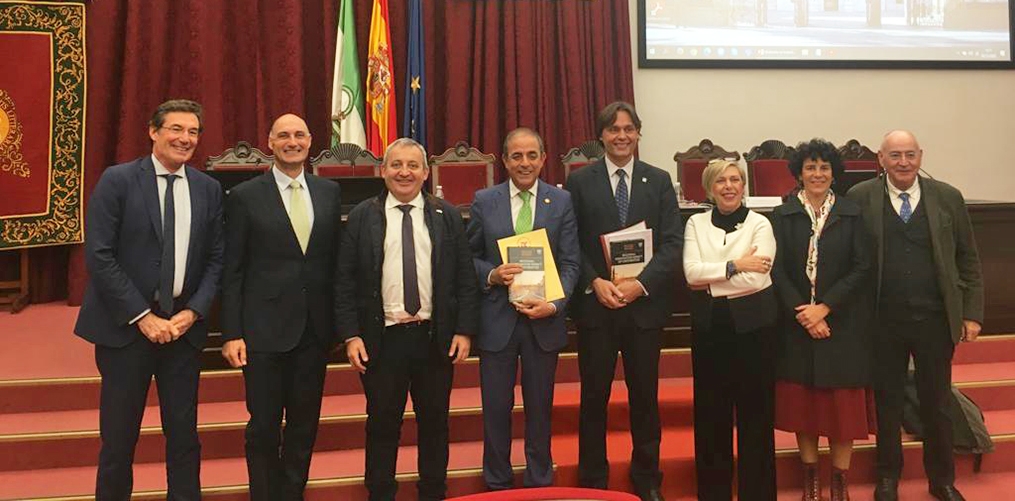
In the photo, from left to right: Mikel Landabaso, director of the JRC in Seville; Vincenzo Cardarelli, head of institutional relations at the JRC in Seville; Juan Miguel González-Aranda, LifeWatch ERIC Chief Technology Officer and Common Facility in Spain-ICT Core Director; Miguel Angel Castro Arroyo, rector of the University of Seville; Francisco Oliva, Blázquez, rector of the Pablo de Olavide University; Carmen Vargas, Vice Chancellor for Internationalisation at the University of Seville; Amapola Povedano, General Director of Employability and Entrepreneurship at the Pablo de Olavide University, and Francisco Solé Parellada, Vice President of the Knowledge and Development Foundation.

Policy Relevance and Uptake

  • End of May 2026 – Policy-brief to demonstrate the application of habitat-based mapping in supporting EU strategies (e.g., Biodiversity Strategy, Nature Restoration Law).

Mapping user requirements

  • End of January 2025 – Catalogue of services already available in LifeWatch ERIC or research lines addressing ecological responses to climate change;
  • February 2025 (TBD) – Online working table on setting priorities, timeline and milestones for the mapping service and model requirements by scientists and science stakeholders.
Greece

The Greek National Distributed Centre is funded by the Greek General Secretariat of Research and Technology and is coordinated by the Institute of Marine Biology, Biotechnology and Aquaculture of the Hellenic Centre for Marine Research, in conjunction with 47 associated partner institutions.

To know more about how Greece contributes to LifeWatch ERIC, please visit our dedicated webpage.

Italy

The Italian National Distributed Centre is led and managed by the Italian National Research Council (CNR) and is coordinated by a Joint Research Unit, currently comprising 35 members. Moreover, Italy hosts one of the LifeWatch ERIC Common Facilities, the Service Centre.

To know more about how Italy contributes to LifeWatch ERIC, please visit our dedicated webpage.

Netherlands

The Dutch National Distributed Centre is hosted by the Faculty of Science of the University of Amsterdam. Moreover, The Netherlands hosts one of the LifeWatch ERIC Common Facilities, the Virtual Laboratory and Innovation Centre.

To know more about how The Netherlands contributes to LifeWatch ERIC, please visit our dedicated webpage.

Portugal

The Portuguese National Distributed Centre is managed by PORBIOTA, the Portuguese e-Infrastructure for Information and Research on Biodiversity. Led by BIOPOLIS/CIBIO-InBIO – Research Centre in Biodiversity and Genetic Resources, PORBIOTA connects the principal Portuguese research institutions working in biodiversity.

To know more about how Portugal contributes to LifeWatch ERIC, please visit our dedicated webpage.

Slovenia

The Slovenian National Distributed Centre is led by the Research Centre of the Slovenian Academy of Sciences and Arts (ZRC SAZU). It focuses on the development of technological solutions in the field of biodiversity and socio-ecosystem research.

To know more about how Slovenia contributes to LifeWatch ERIC, please visit our dedicated webpage.

Spain

The Spanish National Distributed Centre is supported by the Ministry of Science, Innovation and Universities, the Regional Government of Andalusia and the Guadalquivir River Basin Authority (Ministry for Ecological Transition-MITECO). Moreover, Spain is the hosting Member State of LifeWatch ERIC, the location of its Statutory Seat & ICT e-Infrastructure Technical Office (LifeWatch ERIC Common Facilities). 

To know more about how Spain contributes to LifeWatch ERIC, please visit our dedicated webpage.

Bulgaria

The Bulgarian National Distributed Centre is represented by the  Agricultural University-Plovdiv.

To know more about how Bulgaria contributes to LifeWatch ERIC, please visit our dedicated webpage.

Implementing services

  • End of January 2025 – Internal distribution of a questionnaire on the most used/relevant model resources in the WG member research activity;
  • February 2025 (TBD) – Online working table on setting priorities, timeline and milestones for the mapping service and model requirements by scientists and science stakeholders.

Knowledge Exchange and Capacity Building

  • End of December 2025 – Create a shared repository of guidance documents, tools, templates, and data resources accessible to WG members and broader communities.

Organising WG workshops and conferences

  • End of January 2025 – Setting priority research lines and contributions to the BEeS 2025 LifeWatch Conference for the session on the “Ecological responses to climate change”;
  • March/April 2025 (TBD) – Workshop ‘Ecological modelling and eco-informatics to address functional responses of biodiversity and ecosystems to climate change’ co-organised with the University of Salento;
  • 30 June – 3 July 2025 – Participation to LifeWatch 2025 BEeS Conference on “Addressing the Triple Planetary Crisis”.

Fund raising

  • End of January 2025 – Establishing a WG Committee on scouting project application opportunities and fundraising.

Meetings, Webinars, International Conferences & Networking (2025/2026)

  • Organising and participating at discussions on emerging technologies in biodiversity monitoring;
  • Organising webinars on machine learning, eDNA analysis, and automated data collection;
  • Fostering collaboration between researchers, technologists, and decision-makers.

Collaborative Research & Case Studies (2025/2026)

  • Conducting pilot projects to test new monitoring methods;
  • Publishing scientific and popular science papers and reports on advancements in biodiversity assessment.

Data Standardisation & FAIR Principles Implementation (2025/2026)

  • Developing best practices for data curation and sharing;
  • Ensuring that biodiversity data aligns with FAIR (Findable, Accessible, Interoperable, Reusable) standards.

Development of VREs for Ecosystem Simulation (2026)

  • Creating virtual models of ecosystems to predict environmental changes;
  • Enhancing conservation strategies through AI-driven simulations.

Mapping Requirements and Gap Analysis

  • End of December 2025 – Catalogue of services already available in LifeWatch ERIC or research lines Ecosystem services mapping.

Methodological Alignment and Innovation

  • End of January 2026 – Online working table on mapping standards, classification systems, and indicators across members;
  • End of January 2026 – Catalogue of advanced techniques (e.g., remote sensing, GIS modelling, and machine learning) for scalable, habitat-based ecosystem service mapping;
  • End December 2026 – Methodological framework to support methodological innovation through joint development and testing of mapping approaches, especially linking ecosystem service supply and demand.
Belgium

The Belgian National Distributed Centre makes varied and complementary in-kind contributions to LifeWatch ERIC. These are implemented in the form of long-lasting projects by various research centres and universities distributed throughout the country and supported by each respective political authority.

To know more about how Belgium contributes to LifeWatch ERIC, please visit our dedicated webpage.