A new understanding of nature: ITINERIS 2-day training on VREs and presentation of the final platform

ITINERIS

ITINERIS (https://itineris.cnr.it/) is an initiative started in November 2022 with the objective to support the Italian integrated system of Research Infrastructures (RIs) in the environmental domain, under the coordination of the National Research Council (CNR) of Italy.

One of its main outputs is the ITINERIS HUB, a gateway to the wide range of data, cutting-edge facilities, analytical tools, and services from these RIs, facilitating observation and study of processes in the atmosphere, marine domain, terrestrial biosphere, and geosphere. Italy is in fact actively involved in all major pan-European Environmental Research Infrastructures, and hosts other nationally relevant RIs, demanding for coordinated actions to integrate, interlink and harmonise their activities.

The ITINERIS HUB includes digital tools such as datasets, research products, and training resources among others, as well as Virtual Research Environments (VREs), that is, web-based, community-oriented working environments that enable researchers to work remotely and interactively.

Now in its final phases, ITINERIS has recently launched a VREs training event in two sessions, on 27 and on 30 January. The event will be an opportunity to train the platform super-admins and admins on two newly launched VREs developed in collaboration with LifeWatch ERIC by EquiUP SRL. The first one, Biomass VRE, helps study aquatic and terrestrial biomass dynamics in relation to climatic, ecological, and anthropogenic factors, while the second one, Phyto VRE, allows phytoplankton data computation and analysis.

After the training events, the final version of the platform will be presented to its end-users in another session on Friday 30 January at 15:00, together with some practical case studies to help in the adoption of its tools.

Researchers are just beginning to understand the series of intricate relations governing our planet: this is one of modern science’s biggest challenges in the face of today’s critical issues. Platforms like ITINERIS HUB can help elaborate and interpret the huge quantity of data available from different sources and offer a new understanding of nature.

Italy joins GBIF through the establishment of a National Node

LifeWatch Italy & GBIF

As of October 2025, Italy has officially joined the Global Biodiversity Information Facility (GBIF), strengthening its engagement in the international landscape of open biodiversity data.

Already a member of LifeWatch ERIC through LifeWatch Italy, with the National Research Council (CNR) as the leading entity, Italy has now established its national GBIF node, coordinated by DSSTTA (Department of Earth System Sciences and Environmental Technologies). Ilaria Rosati, already actively involved in LifeWatch Italy, has been appointed Node Manager of the Italian GBIF node.

DSSTTA is committed to advancing the understanding of how Earth’s systems, including climate, cryosphere, biodiversity, and related components, are deeply interconnected and influenced by human activities.

The Italian GBIF node builds on national expertise in biodiversity research and data management, contributing to free and open access to biodiversity data at the global scale. GBIF represents the leading international platform for the management and sharing of species occurrence data, supporting research, policy, and decision-making worldwide.

The governance of the Italian GBIF node includes the following representatives:

  • Head of Delegation: Diego Fontaneto (CNR-IRSA)
  • Node Manager: Ilaria Rosati (CNR-IRET)
  • Alternate Head of Delegation: Stefano Martellos (University of Trieste)
  • Additional Delegate: Gabriele Bucci (CNR-IBBR)

This development is significant because membership in GBIF enables Italy to contribute its biodiversity data directly to the world’s largest open-access repository of species occurrence information, supporting international research through science-based knowledge.

Map data image from: OpenStreetMap

OntoPortal Workshop 2025

OntoPortal Workshop

The OntoPortal Workshop 2025, hosted by Freie Universität Berlin at the Department of Mathematics and Computer Science, took place in Berlin from 29 September to 2 October.

Every year, the Workshop brings together members of the OntoPortal Alliance to discuss strategies and future activities. The OntoPortal Alliance is in fact a consortium of several research and infrastructure teams dedicated to promoting the development of ontology repositories, in science and other disciplines, based on the open, collaboratively developed OntoPortal open source software (Source: Clement Jonquet, Jennifer L Vendetti, Guillaume Alviset, Ilaria Rosati, John Graybeal, et al.. OntoPortal Workshop 2024 Report. INRAE; Stanford University. 2024. ffhal-04891214f).

These teams develop and maintain several openly accessible semantic artefact catalogues, or ontology repositories, in multiple domains. Among them, LifeWatch ERIC manages EcoPortal, the repository of semantic resources for ecology and related fields (https://ecoportal.lifewatch.eu).

This year, representatives from EcoPortal (Ilaria Rosati, Martina Pulieri and Michael Griniezakis), AgroPortal (Clement Jonquet, Imad Bourouche), EarthPortal (Christelle Pierkot and Hakim Allem), BiodivPortal (Naouel Karam, Ralph Schäfermeier and Adrian Paschke), BioPortal (Mark Musen, Jennifer Vendetti, Michael Dorf and Alex Skrenchuk), MatPortal (Alexandru-Aurelian Todor), OntoPortal-Astro (Baptiste Cecconi), CHPortal (Beatrice Markhoff, Louise Parkin), SocioPortal (Darren Bell), HSPortal (Anais Guillem) and other guests from NFDI (Roman Baum and Jakob Voss) joined the discussions.

Key topics included ontology development lifecycle, MOD-API implementation, new developments including generative AI and OntoPortal, and collaborations in projects and initiatives.

Biodiversity and Ecosystem responses to Climate Change: scientists in Lecce discuss the invisible cost of the ecological crisis

Biodiversity and Ecosystem Responses

The international workshop “Biodiversity and Ecosystem Responses to Climate Change” took place on 12–13 June 2025 at MUST Museum in Lecce.

The National Biodiversity Future Centre (NBFC), Italy’s first national research and innovation centre for biodiversity, funded by the Ministry of University and Research (MUR) through NextGeneration EU funds, organised the workshop in collaboration with LifeWatch ERIC’s Working Group on Biodiversity & Ecosystem Responses to Climate Change.

Climate change is deeply altering the living conditions of organisms across the planet, influencing their geographic distribution, abundance, and even the daily cost of survival. These effects are especially severe for species which cannot regulate their body temperature and must expend more resources to maintain metabolism and behaviour in warmer, more unstable environments.

The consequences of these changes extend far beyond the ecological sphere. They impact key ecosystem functions that support human well-being, potentially affecting economic growth (GDP) and the achievement of the UN 2030 Sustainable Development Goals (SDGs).

Acknowledging that climate change does not act in isolation but reshapes entire ecological contexts, the workshop focused on assessing possible ecological responses and exploring ways to integrate them into adaptation and mitigation strategies.

One of the central questions guiding the discussions was: How will biodiversity’s response to climate change affect our economy and society in the coming decades?
The reflection was based on a simple yet crucial premise: we cannot safeguard our well-being without first safeguarding the ecosystems we depend on.

The full programme remain available at:
https://www.lifewatch.eu/thematic-services-working-groups/wg-climate-change/meetings/workshop-biodiversity-and-ecosystem-responses-to-climate-change

Join LifeWatch ERIC’s Thematic Services Working Groups

Thematic Services Working Groups

LifeWatch ERIC launches the minisites of the six Thematic Services Working Groups: hubs for knowledge and resources sharing, networking, and collaboration.

Co-developed by the LifeWatch ERIC Common Facilities in collaboration with the National Distributed Centres, they reflect the main priority areas of e-Service construction, and therefore are central to the 2022-2026 Infrastructure Strategic Working Plan.

The Thematic Services Working Groups are coordinated by the LifeWatch ERIC Service Centre and pursue three main objectives:

  • Strengthen collaboration between and within the Common Facilities and the Distributed Centres;
  • Review and update the mapping of the National scientific communities’ research needs in relation to the Thematic Services, and identify priority areas for development;
  • Promote and coordinate the participation of Distributed Centre research institutions in Horizon Europe and other European and international projects, on behalf of and in collaboration with LifeWatch ERIC, to co-design and co-construct the priority services with other key actors in the biodiversity and ecosystem research landscape.

The initiative officially took off in 2024, marked by a series of Thematic Service Workshops hosted by the National Distributed Centres, engaging local communities from the start.

Today, we are glad to present the Working Groups on the website: six dedicated entry points, each focused on a specific topic and open for participation!
Each page offers a brief overview of the scope and objectives, as well as a timeline of activities, including some future actions already planned.

The activities in each group are led by a coordinator from one of our National Distributed Centres, who will oversee the follow-up of its activities.

Moreover, the abstract submission topics for this year’s ‘BEeS’, LifeWatch ERIC’s Biodiversity & Ecosystem eScience Conference, have been selected in alignment with those of the Working Groups, given that they had been previously identified as key priority areas by the National Distributed Centres.

What are you waiting for? Find out more about the Working Groups, join forces with fellow experts and contribute to biodiversity and ecosystem research!

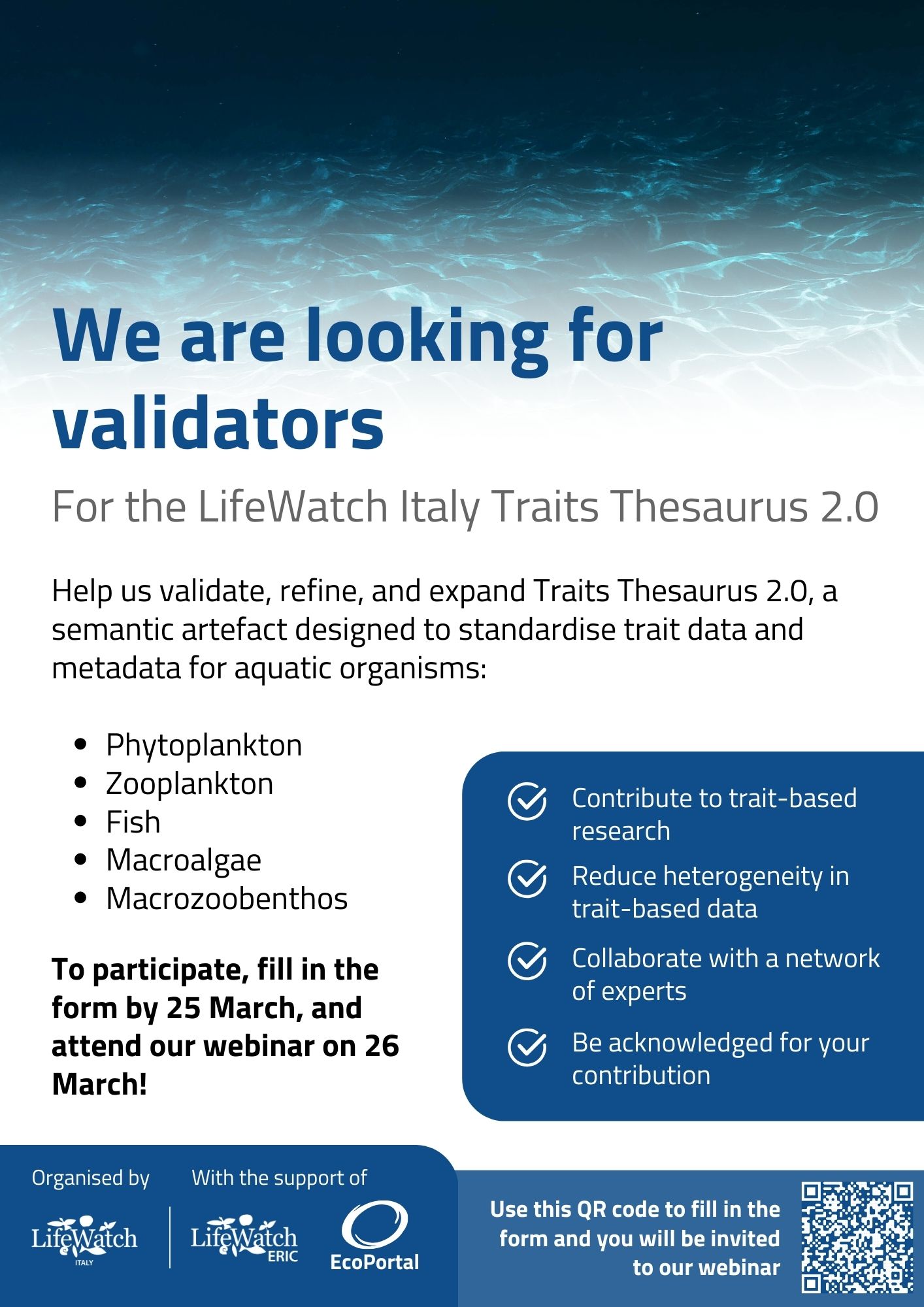
Become a Traits Thesaurus 2.0 validator on EcoPortal

Traits Thesaurus

LifeWatch Italy (https://www.lifewatchitaly.eu/) is launching a Call for Action to validate, refine, and expand the Traits Thesaurus 2.0, a comprehensive semantic artefact designed to standardise trait data and metadata for aquatic organisms, covering diverse biological groups, such as phytoplankton, zooplankton, fish, macroalgae, and macrozoobenthos.

The Traits Thesaurus 2.0 builds upon, and integrates, pre-existing thesauri, originally developed within LifeWatch Italy, into a unified and structured framework. The first validated version (1.0), is already available on EcoPortal: https://ecoportal.lifewatch.eu/ontologies/TRAITS_THES.

By becoming a validator, you will:

  • Contribute to trait-based research, and help standardise trait data, supporting scientific progress in aquatic ecology;
  • Reduce heterogeneity in trait-based data, playing a crucial role in developing new standards for trait-based data, and improving the interoperability of trait terminologies;
  • Collaborate with a network of experts;
  • Receive acknowledgement of your contribution by an open-access resource that supports interoperability in trait-based research.

If you decide to join the Traits Thesaurus 2.0 pool of validators, you will review and provide feedback on specific terms and definitions included. The validation phase will last for three weeks, and after the necessary revisions, the updated thesaurus will be published.

If you want to join, fill in this form by 25 March: https://forms.office.com/e/6LGXj2TUJ2?origin=lprLink, to receive the invitation for a webinar on 26 March and learn all you need to know.

Download the leaflet

22nd Italian Ornithology Conference: call for symposia and round tables proposals

ornithology

CISO (Centro Italiano Studi Ornitologici), University of Salento and the Institute of Research on Terrestrial Ecosystems of the National Research Council (CNR-IRET), LifeWatch Italy and Or.Me. organise the 22nd Italian Ornithology Conference. The conference will gather ornithologists and natural science enthusiasts together in Lecce, a first edition for the Apulia region in more than 40-year history of ornithology conferences.

Participants are invited to submit proposals for symposia and round tables, proposing topics of their own particular interest or general relevance. Any symposium should therefore focus on a well-defined topic that could appeal to a wider audience than just specialists in the field.

Symposia will have to follow a specific structure with six oral presentations, an introduction and a conclusion. The proposals will be evaluated based on the relevance of the topic, interest and originality, as well as gender and geographical balance criteria.

Round tables will last one hour and a half. A brief initial introduction by the organisers is welcome, but the round table must primarily promote discussion and active interaction among the participants.

The submission deadline is 10 February 2025.

For more information visit:

https://www.lifewatchitaly.eu/en/22-convegno-italiano-di-ornitologia/symposia-and-round-tables/

LifeWatch Italy Conference 2025

LifeWatch Italy Conference 2025

Wednesday, 29, and Thursday, 30 January will see the LifeWatch Italy team engaged in its Annual Conference 2025 in Rome, hosted at the National Research Council of Italy (CNR). This important event brings together researchers to explore the latest research and technological advancements in biodiversity and ecosystem.

Italy is a biodiversity hotspot in Europe and one of the founders of LifeWatch ERIC, hosting its Service Centre in Lecce. The LifeWatch ERIC Italian National Distributed Centre is led and managed by the CNR and is coordinated by a Joint Research Unit, currently comprising 35 members. With over 57,400 animal species and 6,500 plant species, Italian landscapes and protected areas serve as natural laboratories for ecological studies.

LifeWatch Italy’s activities span a wide range of data-driven and technological solutions: from the development of controlled vocabularies and ontologies for data interoperability to ensuring FAIR data and metadata. The infrastructure also supports ICT services, Virtual Research Environments (VREs), Learning Platforms, and Citizen Science initiatives.

This year’s conference will focus on strategic developments for LifeWatch Italy, promoting collaboration with other research infrastructures and relevant national-level projects. Discussions will explore taxonomic and biogeographical data, climate change impacts, and new modelling approaches, alongside research on marine and terrestrial biodiversity, bio-cultural heritage, and ecosystem stressors. The event will also highlight technological innovations, including cloud computing, reference genomes, and new research platforms developed through LifeWatchPLUS.

For the detailed agenda, visit: https://www.lifewatchitaly.eu/conferenza-lifewatch-italia-2025/

Sandy Beaches Symposium: the world’s leading experts gather in Lecce

The IX International Sandy Beaches Symposium was held in Lecce, Italy, on June 24-27 2024. The event was an opportunity to bring the world’s leading experts on sandy coastal ecosystems together in the city.
Past, present, and future of sandy beaches were at the center of the symposium: biodiversity loss, abundance, distribution and dynamics of species of sandy beach ecosystems, climate change impacts, anthropogenic pressures (fisheries, tourism, etc), urbanization, the key role of marine protected areas, and the challenges of creating a network between them, coastal erosion and mitigation strategies, insights from environmental DNA metabarcoding and advanced statistical models, are some of the many topics brought up for discussion by experts from all over the globe.

From Orkney sandy beaches, in Scotland, to the coastal ecosystems of Namibia and Costa Rica, to the sandy beaches of California and Apulia region: the event gathered some of the most renowned experts in the field, offering a unique opportunity to explore the latest research and developments in this disciplinary area, while illustrating to the public the importance of sandy beaches and the challenges we are facing in safeguarding these fragile and threatened ecosystems.

The symposium was an opportunity to present and discuss the state of the art in the field of sandy beach research, from a national, regional and global perspective. The event was organized by the University of Salento, with the support of LifeWatch ERIC.

Among the scientists invited as high-level keynote speakers were: Prof. John M Baxter, University of St Andrews and Heriot-Watt University; Prof. Omar Defeo, Unidad de Ciencias del Mar, Universidad de la Republica, Uruguay; Prof. Mike Elliott, Professor of Estuarine and Coastal Sciences at the University of Hull, UK; Dr. Shinji Sassa, Chair of the International Technical Committee on Scour and Erosion National Institute of Maritime, Port and Aviation Technology, Japan; Prof. Alberto Basset, Full Professor of Ecology at the University of Salento and LifeWatch ERIC Service Centre Director; Dr. Lucia Fanini, researcher at the University of Salento, etc.

To learn more about the International Sandy Beaches Symposium, please visit the dedicated website: https://isbsymposium.org/

A future for the Critical Zone? Insights from the Gran Paradiso Summer School 2024

gran paradiso summer school

From 19 to 23 June in Valsavarenche, Italy, scientists, researchers, and students from various disciplines are attending lectures, workshops, and fieldwork sessions at the Gran Paradiso Summer School. This year, the school’s theme is “Fundamental Processes in Earth System Dynamics – The Future of Critical Zone”.

Hosted at the Gran Paradiso National Park, the school aims to foster a deeper understanding of Earth Sciences, with lecturers from Europe, the United States, Japan, and Taiwan. Thanks to its interdisciplinary approach, it provides a platform for geologists, ecologists, hydrologists, and scientists working in these fields to collaborate and share their expertise. Our CEO, Christos Arvanitidis, is participating in the Summer School programme, presenting LifeWatch ERIC’s activities in the Special Seminars session.

Participants also have the opportunity to discuss multidisciplinary and cross-domain interactions, which are crucial for developing comprehensive strategies. These conversations aim to bridge the gap between scientific research and practical applications, ensuring that the knowledge gained can inform future actions and conservation efforts.

The international Gran Paradiso Summer School is organised by Timothy White (Pennsylvania State University, USA) and Antonello Provenzale (CNR IGG, Pisa, Italy, and Coordinator of the LifeWatch Italy Joint Research Unit) in the framework of the Belmont Forum ABRESO project and of the Italian project coordinating a network of national nodes from 22 Research Infrastructures (ITINERIS), in collaboration with the Gran Paradiso National Park, LifeWatch ERIC, and eLTER RI. To learn more about the school, please visit this page: https://www.thematic-school.cnr.it/about-the-summer-school/.