New EU project MarineSABRES to tackle coastal and marine biodiversity decline

marine biodiversity loss

LifeWatch ERIC is pleased to announce that it is involved as a partner in a new, EU-funded research project called MarineSABRES. The project aims to address the continued and accelerated biodiversity loss caused by the intensification of human activities at land and sea. The project — coordinated by MaREI, the SFI Centre for Energy, Climate, and Marine Research at University College Cork — will bring together an international consortium of 22 partners across 11 countries and will receive €9.8m in funding from Horizon Europe, the EU’s key funding programme for research and innovation. Running for four years, MarineSABRES aims to enable stakeholders from government and policy, coastal and marine management, scientists, and the public to make informed decisions that balance human and ecosystem needs.

To set European marine management on a course to reverse biodiversity decline, MarineSABRES will bring together diverse audiences and perspectives to co-design a simple Socio-Ecological System (SES) framework. The aim of this approach is to strengthen interventions and measures for the protection and conservation of coastal and marine areas and improve the uptake of ecosystem-based management. The Simple SES will be tested in three areas: the Tuscan Archipelago, where research will focus on seagrass conservation and protection; the Arctic (Greenland, the Faroes, and Iceland), where work will address climate change and fisheries; and Macaronesia (Azores, Madeira, and the Canaries), where the emphasis will be on biodiversity conservation and the responsible use of the region for multiple maritime activities.

The coming decade will be critical in meeting the challenge of climate change, reversing trends in biodiversity loss, and developing a sustainable ocean economy. Effective marine environmental management and biodiversity protection are fundamental to achieving the transformation to a modern, resource-efficient, and competitive low-carbon sustainable ocean economy. MarineSABRES’ Simple SES approach aims to show how we can protect and maintain the natural structure and processes of marine ecosystems while simultaneously delivering the societal goods and benefits that people rely on. Successful development of this Simple SES will enable managers to make sustainable decisions; empower citizens to engage with marine biodiversity conservation; promote sustainable development in coastal and marine sectors and setting European marine management on a course to reverse biodiversity decline.

You can find more detailed information on this project at the following page

You can learn more about the projects in which LifeWatch ERIC is involved on the Related Projects page

Stepping Closer to Biodiversity 2030 with Biodiversa+

Data Interoperability

On 1 September, alongside 37 other participants, LifeWatch ERIC took part in the Data Interoperability and Harmonisation workshop organised by Biodiversa+, with a presentation from LifeWatch ERIC Web Portal Officer, Lucia Vaira. During her presentation, she gave an overview of the EOSC Interoperability Framework in technical, semantic, organisational and legal terms, explaining the (Meta)data structure and workflows within LifeWatch ERIC, along with the status and main challenges of interoperability within the Infrastructure.

Biodiversa+ is the European Biodiversity Partnership supporting excellent research on biodiversity with an impact for society and policy. It was jointly developed by BiodivERsA and the European Commission as part of the EU Biodiversity Strategy 2030, and will contribute to the ambition that “by 2030, nature in Europe is back on a path of recovery, and that by 2050 people are living in harmony with Nature”. The Commission recognises that it is vital to make biodiversity data more accessible in order to make faster progress in this research area and achieve the objectives of the EU Biodiversity Strategy.

Lucia Vaira touched on many important topics in her presentation, demonstrating not only key openly-accessible LifeWatch ERIC tools such as the Metadata Catalogue and EcoPortal, but explaining the importance of interoperability to the Infrastructure: In light of the FAIR principles, interoperability essentially means that “research data need to be integrated with other data; and need to interoperate with applications or workflows for analysis, storage, and processing”, principles which are always held in consideration during the development of the Infrastructure’s tools. After all, interoperability is essential to enable the seamless combination of all LifeWatch ERIC’s assets, providing added value for the final users. You can access the full presentation here.

Other speakers at the event included Alberto Basset – Italian Ministry of Universities and Research, Hilde Eggermont – BelSPO, Dani Villero Pi and Nestor Fernandez – EuropaBON, Tim Hirsc – GBIF, and Sujeevan Ratnasingham and Rutger Vos – BIOSCAN/iBOL, with whom a fruitful discussion was held on how Biodiversa+ can help achieve effective data interoperability. LifeWatch ERIC is honoured to participate in opportunities to nurture and maintain multilateral dialogue within the European Research Area to support the EU Biodiversity 2030 Strategy, in line with its mandate to enhance understanding, linkages and synergies between biodiversity loss and other societal challenges. Increased interoperability with other biodiversity databases through the support of Biodiversa+ facilitates the Infrastructure in its mission to mobilise and integrate data and algorithms for biodiversity and ecosystem research.

Biodiversity Plenary at the UNGA77 Science Summit

Biodiversity Plenary

WATCH THE LIVESTREAM

On Friday 16 September, LifeWatch ERIC and GBIF, the Global Biodiversity Information Facility, will organise a Biodiversity Plenary at the United Nations General Assembly (UNGA) Science Summit in New York, which is taking place from 13 – 30 September to mark the 77th General Assembly of the UN. Together, they will present collaborative research systems and examples of innovative digital technologies to meet the challenge set by the SDGs to preserve ecosystems –specifically SDG 14 Life below Water and SDG 15 Life on Land– encouraging better informed decision-making that is firmly rooted in science. Their complementary experiences will be offered both to the national delegations in the General Assembly and to the international community, in order to increase understanding about the resources, procedures and examples of effective interventions that can halt biodiversity loss in the context of climate change – in fact, 40 speakers will participate: representatives and experts from world organisations such as the UN; regional institutions such as the European Commission; and directors of scientific centres and research consortia from all corners of the planet. In particular, the Biodiversity Plenary will call for special attention towards the contribution of agroecology to sustainable agriculture and biodiversity, also drawing on the knowledge of indigenous communities, and will contribute to the preparation of the 2023 UN Summit of the Future, which has the purpose of forging a great consensus in the face of global challenges.

The Plenary on Friday 16 September is one of the four Plenary Sessions of a programme that lasts over 18 days and includes more than 100 events, to examine the role of scientific research and cooperation in achieving the UN SDGs for 2030. It will be broadcast live on the UNGA Science Summit website. During the event, LifeWatch ERIC aims– both through the Biodiversity Plenary and the numerous meetings that it will hold in New York with authorities, diplomats, scientists, conservationists, administrators of resources and social agents– to create awareness of the 2030 Agenda. 

Biodiversity Plenary Programme

The hybrid Plenary, taking place on Friday 16 September in New York from 09:00  â€“ 17:00 EDT, will be opened with contributions from representatives of supranational organisations, including European Commissioners, representatives from UNESCO, and national ministers.
It is split into two sessions; the first focuses on the growing importance of networked research infrastructures, with the data, services and resources that essentially provide the backbone for fundamental and applied science, and the definition of evidence-based policies. It will begin with the panel â€˜Scientific Setting: How biodiversity is crucial to delivering UN’s SDGs and what has to happen now’. This will be followed by the panel entitled â€˜Biodiversity Data: support for global policy optimisation’.
The second session, â€˜Biodiversity Case Studies: Accessing global datasets and using new other forms of technology-enabled evidence to inform policy-making’, is focused on case studies of biodiversity that demonstrate the qualitative leap that access to global data sets brings, using new technologies as a way to broaden scientific evidence, which improves the orientation of policy to manage, preserve or recover ecosystems.

You can find more detailed information regarding speakers on the UNGA Science Summit website.

Balloon Sensor Released to Collect Data on Agriculture Biodiversity Impacts

Balloon Sensor

Andalusia, the region home to the LifeWatch ERIC Statutory Seat and ICT-Core, drives the innovative Smartfood Project in the agricultural and fishing sectors. SmartFood is led by the Andalusia Agency for Agriculture and Fisheries Development (AGAPA), which is part of the Junta de Andalucía, and its aim is to better understand the impact of agriculture on the region’s biodiversity. On Monday 18 July, in Cordoba, a project event was held in which a balloon sensor probe was released, attended by LifeWatch ERIC CEO, Christos Arvanitidis, CTO, Juan Miguel González-Aranda, Project Coordinator, Rocío Moreno Domínguez, Direction Secretary and QARM/FitSM Technical Assistant, María Luz Vázquez Santana, and Satellite & HAPS Operations Manager for Earth Observations and Navigation Applications, Jaime Lobo.

The first flight of the balloon sensor probe took place on Cordoba University Campus, called ‘Rabanales’, with the principal aim of gathering data on the agricultural impact on a natural environment, as well as identifying and quantifying variables associated with ecosystem services in the agricultural sector.

AGAPA Director, JosÊ Carlos Álvarez Martín, commented on the importance of governamental institutions like Junta de Andalucía supporting projects as Smartfood, given the strategic importance of the agriculture and fishing sectors.

In the same vein, Dr Arvanitidis noted that the Andalusian region is a strategic European partner, due to its agricultural potential and natural protected areas becoming a hotspot for the development of these kinds of projects.

Finally, Dr GonzĂĄlez-Aranda highlighted that these types of projects are essential for sustainability development and innovation, so that we can measure the impact of climate change in order to advise better decision-making based on FAIR data. He also mentioned the importance of optimising existing distributed resources by improving our understanding of their associated ecosystem services.

Research Infrastructures Accelerating Global Effort to Achieve Environmental Sustainability

ESOF 2022

Today, 15 July 2022, the ERIC Forum organised an online session as part of the EuroScience Open Forum (ESOF2022), taking place in Leiden from 13 – 16 July 2022.

The session, entitled “Research Infrastructures’ contribution to environmental sustainability” puts Research Infrastructures and the added value they bring to the European Research Area in the spotlight, with their major role in creating new opportunities to advance scientific research, enabling access to large-scale facilities and e-Science infrastructures.

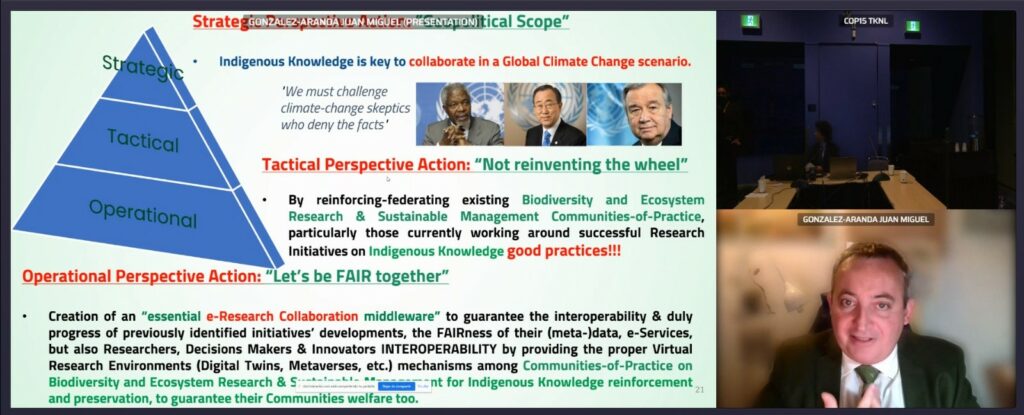
LifeWatch ERIC Chief Technology Officer, Juan Miguel González-Aranda, is joining the session with a presentation on the “The key role of Research Infrastructures to advance Environmental Sustainability through Digital Transformation”. Illustrating the role that LifeWatch ERIC tools like Tesseract and LifeBlock can play in the organisation and management of knowledge, the presentation demonstrates how, through the many projects in which the infrastructure is involved, they can support biodiversity conservation, ecosystem services monitoring and assessment, and ultimately human well-being, contributing to the achievement of the United Nations’ Sustainability Development Goals, as well as the targets of the European Biodiversity Strategy and Green Deal.

Today’s panel also witnesses the participation of ESBB President, Dominik Lermen, Deputy Director of CERIC-ERIC, Ornela de Giacomo, Director General of BBMRI-ERIC, Jens Habermann, and was moderated by the ERIC Forum Chair, and Director of JIVE-ERIC, Francisco Colomer.

“A Window on Science” Renewed for Third Season

AWOS S3

We are back for another season! The first LifeWatch ERIC podcast season focused on the Internal Joint Initiative, the construction of Virtual Research Environments (VREs), and the second drew on the five validation cases used to develop those VREs. Season Three starts up on 20 July 2022, moving a little outside the infrastructure itself into the broader world of Open Science, Invasive Alien Species and practical applications of the LifeWatch ERIC VRE. The first five episodes span the August holiday break:

  • Wednesday 20 July: WoRMS (World Register of Marine Species)
  • Wednesday 3 August: Ocean Optimism
  • Wednesday 7 September: The Critical Zone
  • Wednesday 21 September: Essential Biodiversity Variables, and
  • Wednesday 5 October: The ENVRI Project.

These LifeWatch ERIC podcasts will be embedded in our website portal at the following link (find all of Season 1 here and Season 2 here), and are also available on SpotifyGoogle PodcastsApple Podcasts, and Amazon Music. Our overall purpose is to raise awareness of the good work being done to understand and remedy the damage caused by climate change and anthropogenic pressures. So have a look at the video and take a note of the dates!


A Window on Science Season 3 | Podcast Trailer


Change the Channel – LifeWatching WebTV has Landed

LifeWatching Science Channel

Calling everyone with a thirst for knowledge! Introducing LifeWatching: the new WebTV for biodiversity research in Europe.

The LifeWatching Science Channel is a free, multi-themed platform, available on any device, at any time, providing you with your fill of up-to-date, on-the-ground videos from key players in the European research landscape.

On this new WebTV exclusively for video content on biodiversity and ecosystem research, you can learn about current projects and higher education programmes at national and European level, dive into the hidden worlds of wild creatures and the scientists who keep track of them, as well as follow high-level conferences and events, past and present.

Additonally, LifeWatching will soon be further enriched with videos with dedicated channels for the LifeWatch ERIC member states. Stay tuned!

Get your fill by heading over to www.lifewatching.tv.

The LifeWatching Science Channel is run by specialised personnel at the LifeWatch ERIC Multimedia Production Centre, based at the University of Salento in Lecce, Italy. Please send an enquiry to communications[at]lifewatch.eu if you would like your video to be featured on the platform, if you need technical assistance streaming a live event, or regarding potential collaborations on audiovisual content creation for your research infrastructure/project.

Fostering synergies between LifeWatch ERIC and the Huelva Province

Huelva

On 8 July, a LifeWatch ERIC delegation composed of the Chief Technology Officer, Juan Miguel GonzĂĄlez-Aranda, and LifeWatch ERIC QARM – FiTSM Technical Assistant for ICT-Core, MarĂ­a Luz VĂĄzquez-Santana, together with the Coordinator of the main initiative of the Smart Food AgroEcology Andalusia ERDF, RocĂ­o Moreno, met with the President of DiputaciĂłn of the Huelva province, MarĂ­a EugenĂ­a LimĂłn.
The question at the heart of the meeting was how to foster ongoing collaborations and create new synergies between the e-Science Research Infrastructure, LifeWatch ERIC, and the Province of Huelva: a strategical area playing a pivotal trans-boundary role in the Euroregion Algarve-Alentejo-AndalucĂ­a and the DoĂąana Natural Area.
In the framework of the Europe of the Regions vision, LifeWatch ERIC has been involved since 2014 and working to enact the “Thinking globally, acting locally” motto, in particular in the domains of Citizen Science and Gender and Inclusiveness, the latter carried out within the framework of the GenderWatch initiative.

EU-SOLARIS at LifeWatch ERIC ICT-Core Office

EU-SOLARIS at LifeWatch ERIC ICT-Core Office

On 2 June, Eng. Antonio LĂłpez-MartĂ­nez, Project Manager and Coordinator of EU-SOLARIS, visited the LifeWatch ERIC ICT-Core premises in Seville. EU-SOLARIS is the European SOLAR Research Infrastructure for Concentrated Solar Power based in Almeria (Spain), which entered the ESFRI roadmap in 2010, becoming a landmark in 2018, and which will be established as an ERIC (European Research Infrastructure Consortium) in October 2022.

EU-SOLARIS ERIC will be hosted by CIEMAT, the Centre for Energy, Environmental and Technological Research (Centro de Investigaciones EnergĂŠticas, Medioambientales y TecnolĂłgicas) at the PSA, the Almeria Solar Platform (Plataforma Solar de AlmerĂ­a) premises.

The EU-SOLARIS vision is to further assist Concentrating Solar Thermal (CST) and Solar Chemistry technology deployment by enhancing the research infrastructure’s development and Research and Technology Development (R&D) coordination. EU-SOLARIS is expected to be the first of its kind, where industrial needs and private funding will play a significant role.

“LifeWatch ERIC is looking forward to the imminent establishment of EU-SOLARIS as a European Research Infrastructure Consortium”, says Dr Juan Miguel Gonzaléz-Aranda, LifeWatch ERIC Chief Technology Officer, “We are glad to welcome today Eng Lopéz-Martínez at the ICT-Core office here in Seville. We are already working together, as energy and environment are two domains which are critical for a more sustainable future”.

Biodiversity Day 2022: Gender equality is essential to accelerate progress towards biodiversity

Biodiversity Day

Gender (SDG 5) is a game-changer to accelerate progress towards achieving biodiversity objectives.[1]

The stakes are high, and it is therefore critical to ensure that women also have the opportunity to contribute to supporting biodiversity goals. In many parts of the world, specific daily roles for women and men mean that they have specialised knowledge in different areas of biodiversity, and also different priorities. This means both women and men have a lot to contribute to biodiversity and ecosystem management. 

However, women’s perspectives are often not taken into account, even though they are often more vulnerable than men to the ecological crises that arise from issues such as biodiversity loss, and in some cases and have reproductive, productive and community roles to play in society. Such “gender gaps” are therefore also important entry points for women’s empowerment, where women are supported to overcome gender gaps and fulfil their potential – including in decision-making, to promote biodiversity.

Gender inequality coupled with the climate crisis is one of the greatest challenges of our time. It poses threats to ways of life, livelihoods, health, safety and security for all around the world.

At the European level, LifeWatch ERIC is building a Gender Equality Plan that ensures that women are not only included as part of programmes, policies, research and management teams, but that we endeavour to ensure that all research projects funded by the European Commission are monitored to ensure inclusion of the perspective of men and women and the different gendered impacts that any situation has on the environment and on people’s lives and wellbeing.

We believe that without inclusion and equality, sustainability of the planet is not possible.

May we have the wisdom to work together and reflect on these important issues during World Biodiversity Day 2022.

Africa G Zanella Gender Consultant LifeWatch ERIC and Civil Society Observer and Gender Initiatives Focal Point for Climate Investment Fund @World Bank.


[1] â€œAddressing Gender Issues and Actions in Biodiversity Objectives” by the Convention on Biological Diversity.