Andalusian Government Commends LifeWatch ERIC as an Invaluable Ally in the Green Revolution

Green Revolution

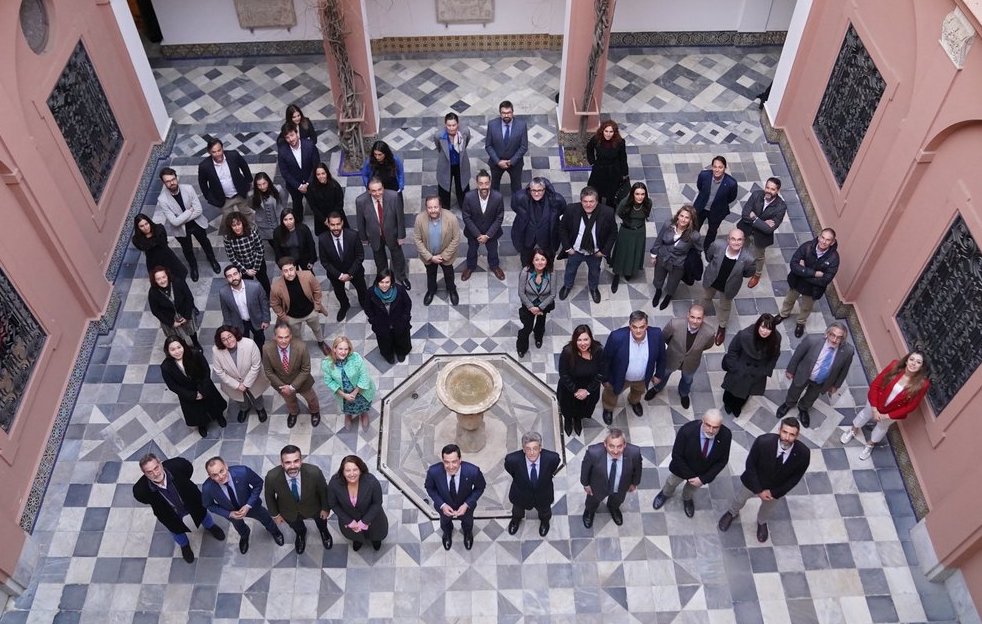
On Thursday 2 February, directors and representatives of the LifeWatch ERIC Common Facilities in Seville were welcomed to the government office of the Andalusian president, Juan Manuel Moreno Bonilla. LifeWatch ERIC members were invited for an afternoon at the beautiful Palacio de San Telmo in Seville with the President, who described the infrastructure as an “invaluable ally” in the Green Revolution, which is being widely promoted in the region.

The President praised the infrastructure for its open science model, through which it can provide advanced digital analysis tools to stakeholders for the conservation and restoration of biodiversity and ecosystem services, highlighting the synergies between the infrastructure and the regional Ministries of Sustainability, Environment and Blue Economy and that of Agriculture, Fisheries, Water and Rural Development, whose respective ministers, Carmen Crespo, and Ramón Fernández-Pacheco, were both present for the occasion. He underlined how the government can make use of LifeWatch ERIC’s expertise in cutting-edge technologies such as AI in a number of ERDF projects, which rely on digitisation and innovation processes to generate environmental knowledge, in order to foster a culture of sustainability.

Good examples include the SmartFood project, in which LifeWatch ERIC is collaborating with Ministry of Agriculture and a number of partners to launch its first nanosatellite this year, which will offer useful information to helpadvance the sustainability of agriculture and fisheries, contributing to the digitisation of the primary sector. Another fine example is the Índalo project, which proposes building a technological infrastructure from which to monitor environmental changes in Andalusia in order to define the most suitable measures for resource management.

LifeWatch ERIC is grateful to the president and the Andalusian government for the gesture of recognition, and is honoured to provide tools and services which can contribute to the betterment of the environment in the region.

You can watch the President’s speech here (in Spanish).

Addressing climate change, biodiversity loss and habitat degradation towards a sustainable management of European wetlands

RESTORE4CS

RESTORE4Cs, a freshly started project led by the University of Aveiro, will address management and restoration actions to maintain and promote the mitigation and adaptation capacity of European wetlands to climate change, while focusing on coastal wetlands and providing innovative tools and methodologies for decision making and restoration planning and actions.

What is the potential of wetlands? How can multiple challenges such as climate mitigation and adaptation, biodiversity conservation, disaster risk reduction and other threats to ecosystem services be tackled to foster mutually reinforcing actions and enhance co-benefits from wetland restoration?

All major European Union (EU) policies recognise the key role of wetlands to achieve the EU objectives regarding climate neutrality, biodiversity protection, zero-pollution, flood protection, and circular economy. Therefore, assessing the current extent and state of European wetlands, their current and potential greenhouse gases (GHG) profile and their medium to long-term mitigation capacity through restoration, or other measures, are key priorities of the European Union to tackle climate change. Led by the University of Aveiro, the recently awarded Horizon project RESTORE4Cs (Modelling RESTORation of wEtlands for Carbon pathways, Climate Change mitigation and adaptation, ecosystem services, and biodiversity, Co-benefits) will assess the role of restoration action on wetlands capacity in terms of climate change mitigation and a wide range of ecosystem services using an integrative socio-ecological systems approach. 

The kick-off meeting, held in Aveiro from 16 to 19 January, has officially marked the start of the project consortium’s activities, gathering representatives of 15 partners from 9 European countries, including universities, research institutes and infrastructures, small and medium enterprises, intergovernmental organisations and NGOs, bringing together a well-structured and multi-disciplinary team, holding all the essential expertise to be at the forefront of the research/policy interface. The meeting agenda covers all aspects of the project implementation, spanning from administrative issues, overview of the state of the art, coordination, communication and organisation of the work. Case pilot sites have been presented by the related local teams and a first visit in the field has been organised in the area pertaining to Ria de Aveiro.

Focusing on coastal wetlands across Europe, RESTORE4Cs will deliver standardised methodologies and approaches for the prioritisation of restoration, promoting carbon-storage and GHG emissions abatement, while improving the ecological status and the provision of additional ecosystem services, such as flood regulation and coastal erosion protection. More in detail, the project will provide online, user-friendly and integrated tools as unique entry points for wetland practitioners and decision makers regarding the prioritisation of conservation and restoration actions, in relation with their GHG performance as well as impacts on biodiversity and a wide range of ecosystem services while addressing in parallel three spatial scales (local, national, regional/pan-European) combined with the three targeted habitats (wetlands, floodplans and peatlands).

See the full press release, with more information on the project breakdown and consortium members, here.

LifeWatch ERIC and Andalusian Government Announce Details on SmartFood Nanosatellite Launch

SmartFood nanosatellite launch

The Councillor for Agriculture, Fisheries, Water and Rural Development of the Junta de Andalucía, Carmen Crespo, was welcomed to LifeWatch ERIC’s ICT-Core office in Seville yesterday, accompanied by the director of the Andalusian Agricultural and Fisheries Management Agency (AGAPA), José Carlos Álvarez, to discuss trailblazing agroecology initiatives which will have wide-ranging impacts. 2023 is an exciting year for LifeWatch ERIC, as it gains traction in the EU research and innovation sector.

LifeWatch ERIC has a strong historic collaboration with the Junta de Andalucía, one such synergy being with the AGAPA on the ERDF SmartFood project, for which a nanosatellite equipped with a very high resolution multispectral camera will be launched in October this year from a Space X base in the United States. The aim of the SmartFood project is to monitor the impact of agriculture, livestock and fishing on the sustainable management of biodiversity and ecosystems ­– LifeWatch ERIC has the technological lead here, and is creating the nanosatellite mission control centre “eBRIC” (eBiodiversity Research & Innovation International Centre) in the Doñana National Park, in partnership with the University of Huelva. Among other things, the centre will focus on interconnected sensorisation at the terrestrial, atmospheric (observation stations, drones) and spatial level (satellites); the study of invasive species; aquifer conservation; native flora and fauna protection; and virtual laboratories for scientific research in the Cloud, using ICT such as Big Data, Artificial-Deep Intelligence “Deep Learning”, and especially Blockchain, through the LifeWatch ERIC LifeBlock tool. The infrastructure conceives the e-BRIC as an international reference centre for Europe, Africa, and Latin America and the Caribbean, aligned with the United Nations through the UNOOSA Office for Biodiversity and Climate Change.

Crespo also congratulated the infrastructure on being chosen to play a key technological role in the AELLRI EU Partnership initiative proposed by the European Commission, as part of the Horizon Europe topic provisionally entitled “Accelerating farming systems transition: agroecology living labs and research infrastructures”, to pioneer the EU’s agricultural transition towards sustainable agroecological models. She highlighted “the importance of the research work carried out by Lifewatch ERIC, offering important data that allows better decisions to be made in the pursuit of sustainable agriculture and preserving biodiversity”, citing how these technological innovations will support Andalusia in reaching and maintaining EU ecological agricultural objectives, both on land and at sea.

CTO Juan Miguel González-Aranda underlined the importance of the agricultural, fishing and livestock sector within the green and blue development paradigms, in coordination with the Green Deal and Blue Growth policies of the EU, and expressed his gratitude for the institutional support, especially from the Ministry of Agriculture, pointing out that “biodiversity cannot turn its back on the primary sector, which is so important for the Autonomous Community of Andalusia”.

The Call for EOSC FAIR Champions is Open!

EOSC FAIR Champions

FAIR-IMPACT, a Horizon Europe project in which LifeWatch ERIC partners, has announced the opening of its call for EOSC FAIR Champions, a group of 12 experts that will be actively engaged in analysing and shaping FAIR data policies and practices in their field who will be on board to act as ambassadors for FAIR, engage their community, and advocate for adoption of the project results.

The candidate Champions will be engaged in identifying research data gaps and needs within their communities, to create broader engagement with FAIR, and to shape and disseminate the outcomes of the FAIR-IMPACT project, for instance by facilitating national roadshows in their country, and contributing to the development of FAIR implementation stories.

FAIR-IMPACT is looking for Champions who have broad expertise in FAIR policy and/or practice, bring strong research data advocacy experience and excellent communications skills, are driven to help mobilise others to generate more FAIR data on policy and/or practice level, and are keen to share best practices. Gender diversity, a balanced geographical and stakeholder representation, and broad interdisciplinary expertise across FAIR policy and practice will be ensured in the evaluation of the profiles.

Click here for more details on how to apply. The deadline to apply is Friday 10 March at 17:00 CET.

Punta Tech Meetup 2023

Punta Tech

Punta Tech Meetup is among the foremost technology networking events in the Latin America and Caribbean. Held this year on Monday 9 January at the Punta del Este Convention and Exhibition Centre in Uruguay, it was attended by entrepreneurs from the region and around the world, who gathered to promote business opportunities. Meetup 2023 also focused on promoting gender equality, creating a space for dialogue between women. 

LifeWatch ERIC was represented by Maite Irazábal Plá, EU-LAC Fundraising, Networking & Projects Manager, who networked with key stakeholders in the technology and business world, exchanging ideas and strengthening connections. The event, which started 15 years ago when three friends decided to get together and have a BBQ “asado”, has grown into an international ecosystem that meets once a year to discuss trends in the industry.

The ‘W Meetup’ stimulus network was designed to recognise, celebrate and promote the development of women in a sector in which gender gaps still persist. Stimulating talent and multiplying opportunities will not only increase the number of women employed in technology companies, but open up career paths that lead to decision-making roles.

Another feature of Punta Tech 2023 was the ‘Prompt Battle’, which pitted competitors against each other using text-to-image software. Seven live ‘battles’ allowed participants to vote for the most creative, surprising and innovative exponents of this Artificial Intelligence software, in which images and art are generated from written descriptions called prompts. The event and the synergies created within the region are an opportunity to continue promoting Uruguay as a center for business and export services, especially in the technology sector.

Kick-off meeting of ITINERIS, the Integrated Environmental Research Infrastructures System

ITINERIS

On 19 December 2022, the kick-off meeting of ITINERIS, the Italian Integrated Environmental Research Infrastructures System, was held in Rome. The project, funded with €155 million from the PNRR and coordinated by the CNR (the Italian National Research Centre), involves 22 European research infrastructures.

Gelsomina Pappalardo, CNR researcher and Italian delegate at the ESFRI Forum, who chaired the event, highlighted that: “this is a unique project of its kind, even if it has a formal duration of 30 months, it will change the future of Research Infrastructures in Italy with an impact on research for at least the next ten years”. The project aims to establish an Italian hub for accessing data, services and facilities for interdisciplinary study in the four environmental domains: atmosphere, marine, terrestrial biosphere and geosphere.

Work Package 2 of the project, presented by Carmela Cornacchia (CNR-IMAA Potenza) in collaboration with Ilaria Rosati (CNR-IRET Lecce and LifeWatch Italy) is in fact dedicated to “access”. Access to research infrastructures refers to the regulated use of research infrastructures, and to the services offered by them, be it physical, remote, or virtual access – as in the case of data and digital services. With WP2, ITINERIS aims to ensure the FAIRness of the access as well (Findable, Accessible, Interoperable, Reproducible). The challenge is to coordinate the 22 infrastructures towards alignment with the requirements set by the European Open Science Cloud (EOSC).

WP3, coordinated by Alberto Basset, Director of the LifeWatch ERIC Service Centre and Manager of the LifeWatch Italy Joint Research Unit (JRU), will take care of training internal staff and future users of the infrastructures. More than 60 training courses are foreseen for the next 30 months.

After the presentation of WP4, 5, 6 and 7 dedicated to the four domains, each with the development of specific case studies, Antonello Provenzale, CNR-IGG and Coordinator of the LifeWatch Italy JRU, presented WP8. This WP will develop the Virtual Research Environments for data analysis and modelling of future scenarios in ITINERIS’ domains of interest. “Having a central hub that functions as a gateway for users to the infrastructures” said Provenzale, “will make us an example at a European level”.

Article originally posted on LifeWatch Italy.

Frontiers Paper on Crustaceans Workflow

Crustaceans Workflow

A scientific paper about the LifeWatch ERIC Crustaceans Workflow was published on 4 January 2023 in Frontiers on Environmental Science, the community-driven and peer-reviewed research journals dedicated to making science open, so that scientists can collaborate better and innovate faster to deliver solutions that enable healthy lives on a healthy planet.

LifeWatch ERIC, the e-Science European infrastructure for biodiversity and ecosystem research, launched the Internal Joint Initiative in October 2019 on Non-indigenous Species and Invasive Alien Species (NIS-IAS) because they are considered one of the major drivers of biodiversity and ecosystem change. In this paper, the case study on the trophic biogeography of invasive crustaceans is presented, describing the procedures, resources, and analytical web services implemented in the Tesseract Virtual Research Environment to investigate the trophic habits of two invasive taxa by using carbon and nitrogen stable isotope data. The case study offers a number of analytical tools to determine the variability of the trophic position of invasive crustaceans in a spatially-explicit context and to model it as a function of relevant environmental predictors.

Literature-based stable isotope data of the Atlantic blue crab Callinectes sapidus and the Louisiana crayfish Procambarus clarkii were used to evaluate the functionalities and outcomes of the workflow. The results of the study reveal, both at population-scale and individual-scale, the existence of significant relationships between temperature related variables and the trophic positions of the two species. At relatively higher temperatures, omnivorous invaders occupy higher trophic levels in food webs and become more carnivorous, which in conditions of climate change is likely to increase their overall impact.

Moreover, the functionalities of the Crustacean Workflow within the Tesseract VRE offered by LifeWatch ERIC can be adapted to a wide range of species, and will be further improved to support researchers in monitoring and predicting trophic-related impacts of NIS-IAS. The VRE will also support policymakers and stakeholders in the implementation of effective management and control measures to limit the negative effects of bioinvaders in recipient environments.

Read or download the whole paper here (Di Muri et al).

Click here for links to two related papers:
An individual based-based dataset of carbon and nitrogen isotopic data of Callinectes sapidus in invaded Mediterranean waters
Individual and population-scale carbon and nitrogen isotopic values of Procambarus clarkii in invaded freshwater systems

LifeWatch ERIC Wins Prize at AI for Science Workshop

AI for Science

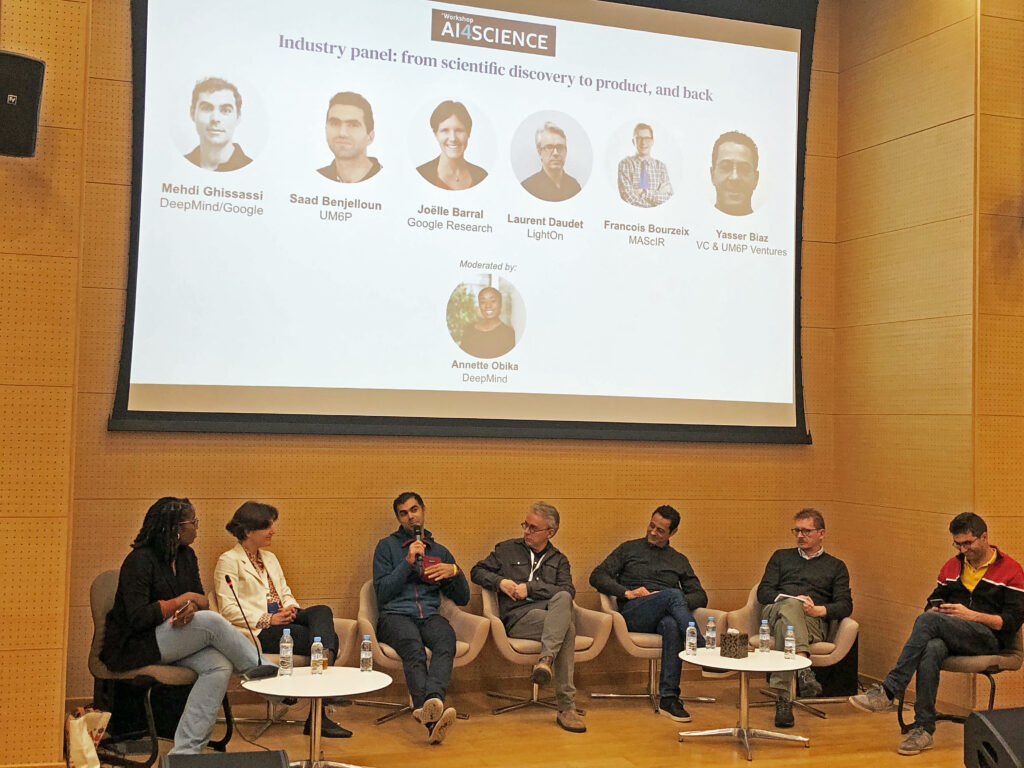
The AI for Science Workshop was held from 12–16 December in Rabat, Morocco, organised by NASSMA, MASCIR, and the Mohammed VI Polytechnic University. Artificial Intelligence offers the promise of revolutionising the way scientific discoveries are done, and tremendously accelerate their pace. However, major challenges still remain in this nascent field of AI for Science, and the goal of this workshop was to address and discuss challenges such as novel methods for AI for Science, tackling the right set of scientific problems, enabling scientific discoveries with AI, and the journey from scientific discovery to a practical application. 

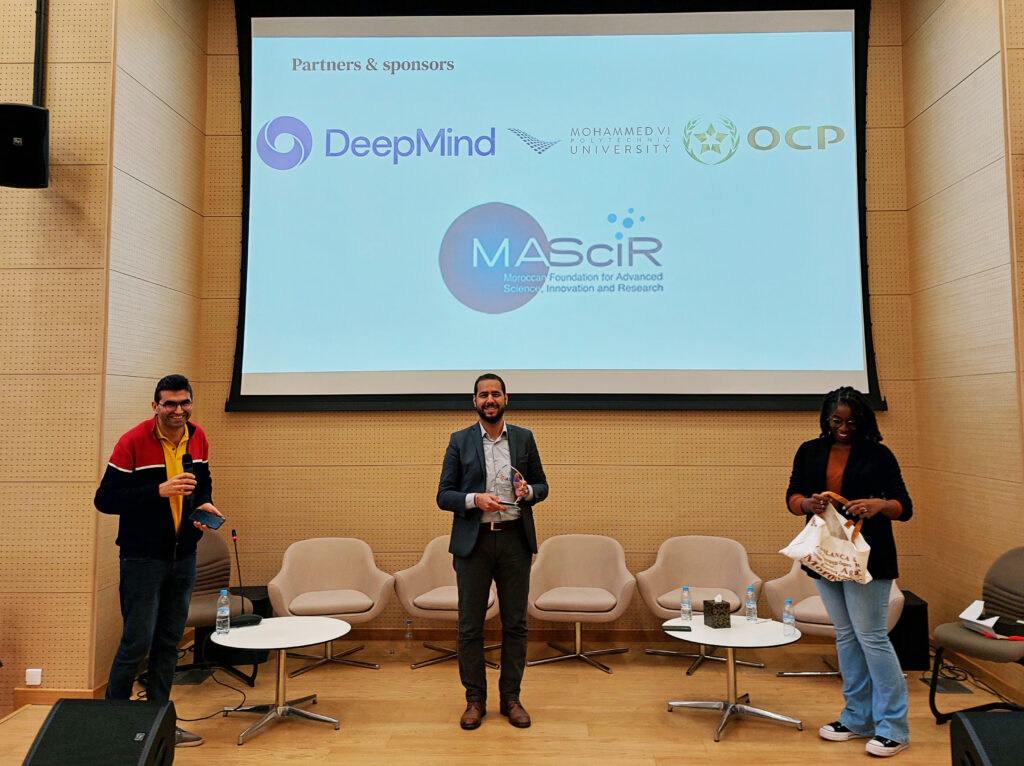
LifeWatch ERIC was represented at the event by its Data Science & Artificial Intelligence Assistant, Yassir Benhammou, who exhibited the ERDF-funded SmartEcoMountains project, which combines interdisciplinary perspectives to obtain and integrate data on how global change affects mountain ecosystems. He displayed a poster on the project “Satellite RGB images and Time Series datasets for automatic Global Land Use/Cover mapping using Deep Learning”, presenting two Smart Global datasets, TimeSpec4LULC* and Sentinel2GlobalLULC**, to train Machine Learning models to perform land use/cover mapping. These two datasets are published in two renowned journals: Earth System Science Data (IF-2021=11,81) and Scientific Data (IF-2021=8,5). On the final day of the event, it won the “best poster prize”. LifeWatch ERIC is delighted and honoured by the recognition afforded by the panel, which featured representatives of pioneers in AI such as UM6P, DeepMind, University of Cambridge, the Morrocan Foundation for Advanced Science, Innovation and Research and Google.

For more information on projects in which the infrastructure is involved, please see our related projects page.

*Authors of TimeSpec4LULC: Rohaifa Khaldi, Domingo Alcaraz-Segura, Emilio Guirado, Yassir Benhammou, Abdellatif El Afia, Francisco Herrera, Siham Tabik. Article link: https://essd.copernicus.org/articles/14/1377/2022/

**Authors of Sentinel2GlobalLULC: Yassir Benhammou, Domingo Alcaraz-Segura, Emilio Guirado, Rohaifa Khaldi, Boujemâa Achchab, Francisco Herrera, Siham Tabik. Article link: https://www.nature.com/articles/s41597-022-01775-8

LifeWatch ERIC at COP15 US-Africa Summit in Washington

COP15 US Africa Summit

LifeWatch ERIC continued its contribution to COP15 on 12 December, when Chief Technology Officer Juan Miguel González-Aranda gave a presentation to the US-Africa Summit in Washington D.C. entitled “United in BIOdiversity: e-Research Collaboration on (e-)Biodiversity & Ecosystem Sustainable Management in support of the accomplishment of SDG 2030. A Global Challenge”.

Dr González-Aranda’s thesis is that we are moving towards the Sixth Great Extinction, and that it is of essential importance that we address our current environmental challenges and provide knowledge-based strategic solutions to biodiversity loss. LifeWatch ERIC’s Big Data tools allow researchers to assess and monitor ecosystem functions and then provide science-based knowledge so decision-makers can intervene to restore the biodiversity on which human wellbeing depends.  

The US-Africa Summit, 12–16 December, is a side event to the 15th Conference of the parties in Montreal, Canada, the main objective of which is to adopt the post-2020 global biodiversity framework, released in July 2021, and the Aichi Biodiversity Targets. COP15 recognises that urgent policy action globally, regionally and nationally is required to transform economic, social and financial models to reverse the trends that have exacerbated biodiversity loss.

LifeWatch ERIC Contributes to United Nations COP15 Biodiversity Conference in Montreal

COP15

COP15, the United Nations Biodiversity Conference, is not as well-known as the COP27, the Conference of the Parties to the United Nations Framework Convention and Climate Change, held last month in Egypt. However, the Biodiversity Conference, 7-19 December in Montreal, Canada, is the most significant conference on biodiversity in a decade because it will see the adoption of the post-2020 global biodiversity framework, which provides a strategic vision and a global roadmap for the conservation, protection, restoration and sustainable management of biodiversity and ecosystems for the next 10 years.

LifeWatch ERIC, the European Infrastructure for biodiversity and ecosystem research, was represented, virtually, by Chief Technology Officer and Executive Board member Juan Miguel González-Aranda, in an ancillary event on 8 December 2022, organised by the Indigenous Knowledge Research Infrastructure (IKRI), dedicated to addressing the challenges for biodiversity and resiliency of ecosystems. Dr Milind Pimprikar, Chairman of CANEUS, moderated the session, emphasising that indigenous knowledge and practices need to recognised and documented to leverage, integrate and address the urgent challenges the world is facing.

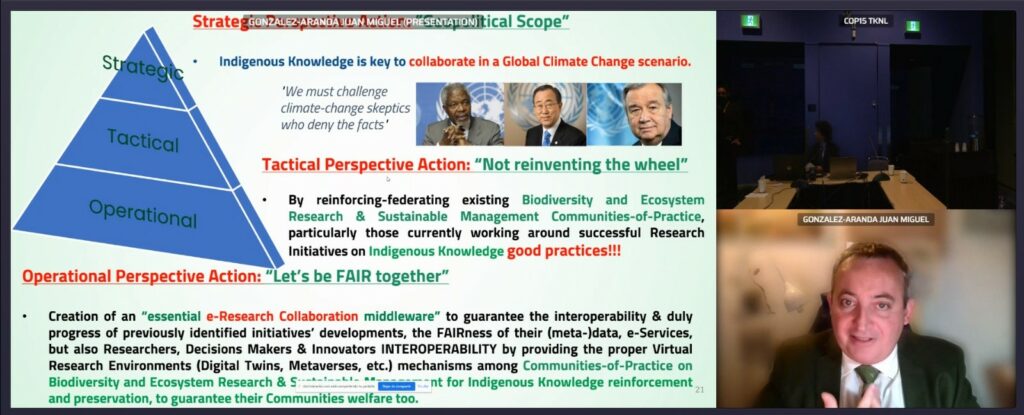
Dr González-Aranda’s contribution described LifeWatch ERIC’s provision of data services as structuring tools in the federation of indigenous knowledge to assist sustainable environmental management, and cited case studies in food, agroecology and green medicine systems. Indigenous knowledge is key to collaborating in a global climate change scenario, he argued, adding that LifeWatch ERIC’s e-Science tools a “Tactical Perspective Action” of not reinventing the wheel, but bringing together sustainable management communities of practice. The infrastructure already works with many countries in guaranteeing the FAIR-ness of data, their interoperability, providing science-based examples of best practice.

The IKRI session at COP15 featured nine other speakers from around the globe and the panel consisted of: Ms. Joan Carling, Executive Director, Indigenous Peoples Rights International, Philippines; Ms. Nāmaka Rawlins, Director of Neʻepapa, Aha Pūnana Leo, Hawaii; Dr. Hussein Isack, Kivulini Trust, Kenya; and Dr. Terence Hay-Edie, GEF Small Grants Programme Advisor, United Nations Development Programme. 

LifeWatch ERIC CTO COP15